
Notes › Physics › GCSE & IGCSE › The National Grid
The National Grid: Step-Up and Step-Down Transformers (GCSE & IGCSE Physics)
Quick answer: The National Grid is the network of cables and transformers that carries electricity from power stations to homes and businesses. Step-up transformers increase the voltage (and lower the current) for transmission; step-down transformers lower the voltage again for safe use. For the same power, a high voltage means a low current (P = IV), so less energy is wasted as heat in the cables.
How electricity gets from the power station to your home, why it is sent at a very high voltage, and what step-up and step-down transformers do. Written from my own lesson boards for GCSE Physics, GCSE Combined Science and IGCSE Physics, with worked examples, a power-loss calculator and exam-style questions.
Try the power-loss calculatorBook a 1-to-1 lessonWritten by Ms. Humaira Asim, a science teacher with 15+ years of teaching experience. Checked against the GCSE (AQA, Edexcel, OCR) and Cambridge IGCSE Physics 0625 specifications.
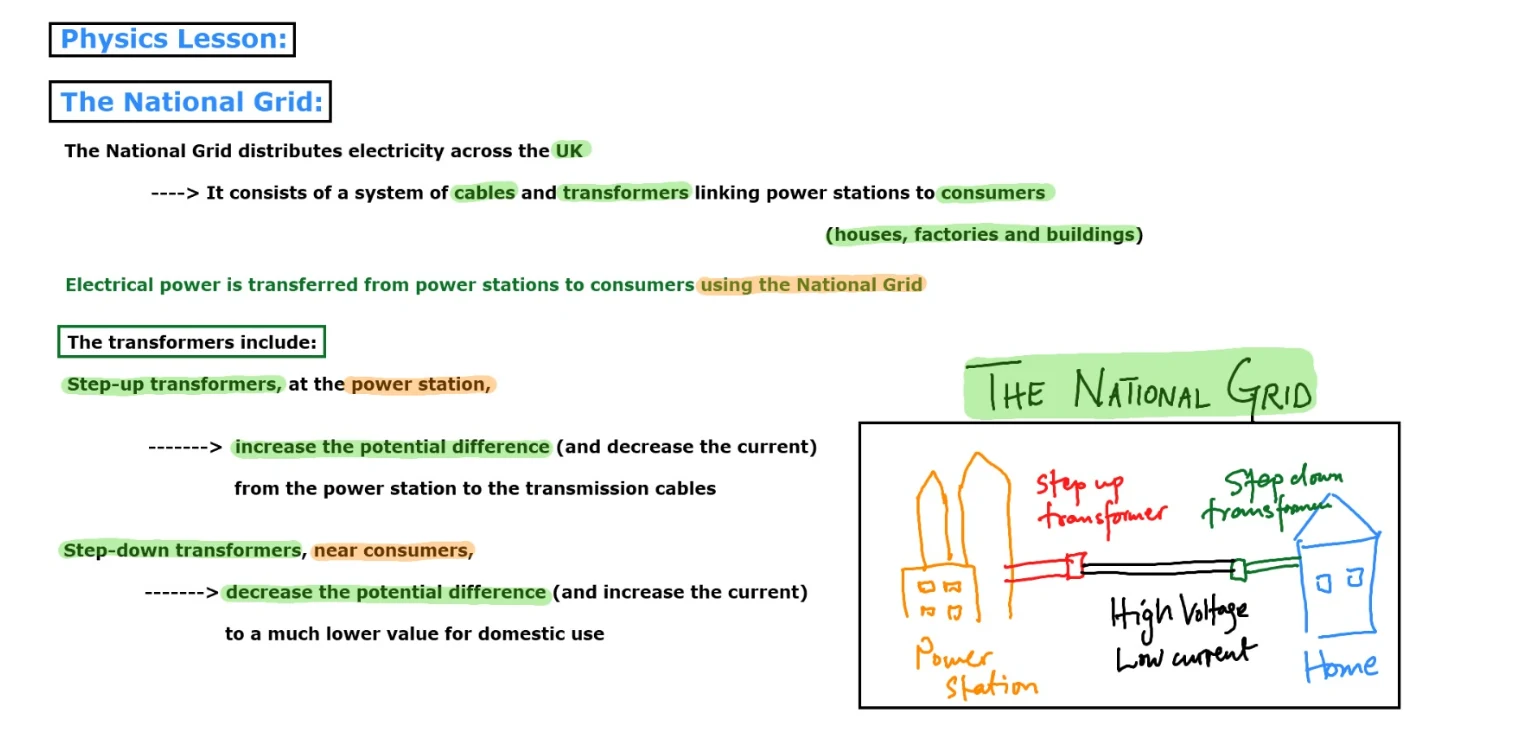
What is the National Grid?
- The National Grid is a network of cables and transformers that links power stations to consumers – houses, factories and other buildings.
- It transfers electrical power across the whole country, so power stations can be built far from the people who use the electricity.
- It uses alternating current (a.c.), because transformers only work with a.c.
- The name “National Grid” is used in the UK. Other countries have the same system and call it the electricity grid or transmission network.
Step-up and step-down transformers
| Transformer | Where it is | Potential difference (voltage) | Current | Why |
|---|---|---|---|---|
| Step-up | At the power station | Increases (e.g. 25 kV → 400 kV) | Decreases | A small current wastes less energy in the cables |
| Step-down | Near consumers (substations) | Decreases (e.g. to 230 V) | Increases | High voltage is far too dangerous for homes |
A transformer changes the voltage and current, but not the power. In an ideal (100% efficient) transformer, the power going in equals the power coming out.
Why is electricity transmitted at high voltage?
- When a current flows through the long cables, their resistance makes them heat up. This is wasted energy.
- The power transferred is P = IV. So the same power can be sent with a much smaller current if the voltage is made very high.
- A smaller current means much less heating in the cables, so less energy is wasted and the grid is more efficient.
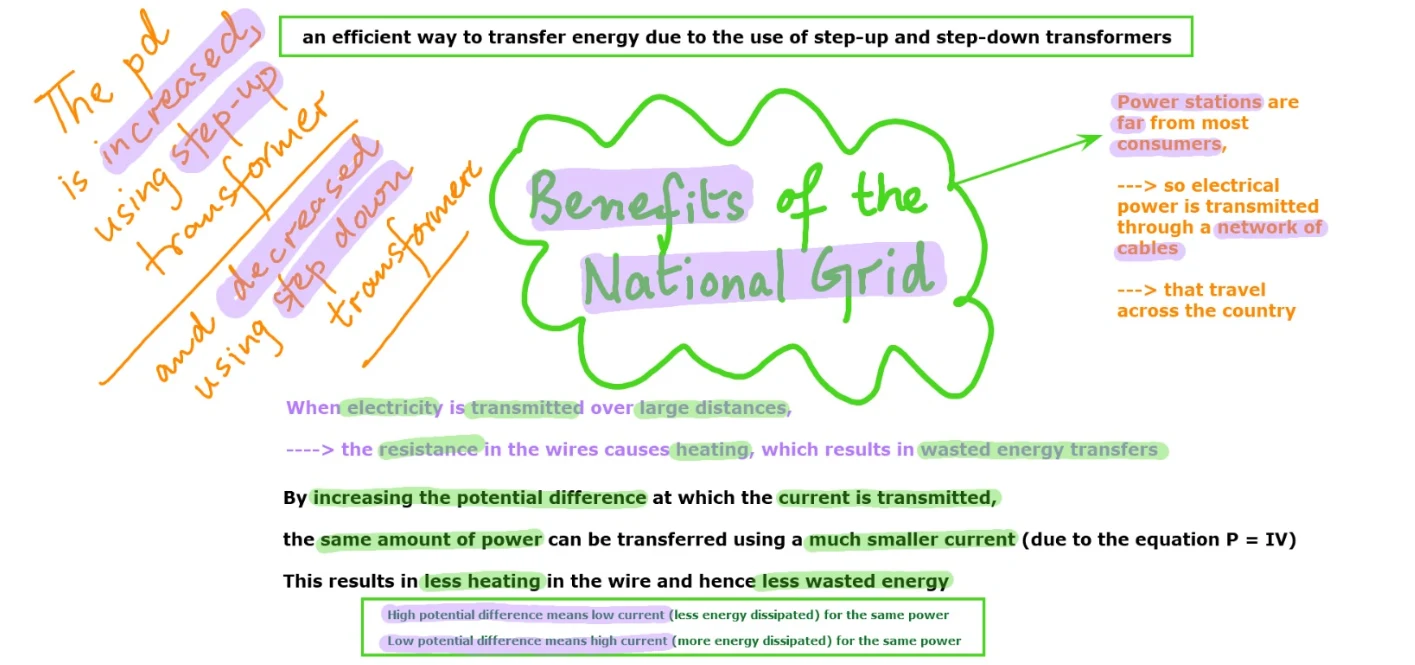
1. The current is lower, so less energy is lost as heat in the cables (more efficient).
2. Thinner, cheaper cables can be used.
Key equations
| Equation | Words | Use it to… |
|---|---|---|
| P = IV | power = current × potential difference | find the current in the cables for a given power |
| P = I²R | power loss = current² × resistance | find the energy wasted as heat in the cables each second |
| Vp ÷ Vs = Np ÷ Ns | voltage ratio = turns ratio | find the voltage or number of turns on a transformer |
| VpIp = VsIs | power in = power out (100% efficient) | find the current after a transformer |
p = primary (input) coil, s = secondary (output) coil. A step-up transformer has more turns on the secondary coil; a step-down transformer has fewer.
Worked examples
Example 1: the current at two voltages
A power station sends 100 MW of power. Calculate the current in the cables at 25 kV and at 400 kV.
- I = P ÷ V
- At 25 kV: 100 000 000 ÷ 25 000 = 4000 A
- At 400 kV: 100 000 000 ÷ 400 000 = 250 A – sixteen times smaller.
Example 2: the energy wasted (Higher / Extended)
The cables in Example 1 have a resistance of 5.0 Ω. Compare the power wasted as heat.
- Power loss = I²R
- At 25 kV: 4000² × 5.0 = 80 MW – 80% of the power is wasted!
- At 400 kV: 250² × 5.0 = 0.31 MW – only about 0.3% is wasted.
Example 3: number of turns (Higher / Extended)
A step-down transformer changes 230 V to 12 V. The primary coil has 2300 turns. How many turns are on the secondary coil?
- Ns = Np × Vs ÷ Vp = 2300 × 12 ÷ 230
- = 120 turns
Example 4: current after a transformer (Higher / Extended)
A step-up transformer changes 25 kV to 400 kV. The current in the primary coil is 2000 A. Assuming it is 100% efficient, find the current in the secondary coil.
- VpIp = VsIs → Is = 25 000 × 2000 ÷ 400 000
- = 125 A
Power-loss calculator
How much energy do the cables waste?
Change the transmission voltage and watch the current and the wasted power change. This is why the National Grid uses step-up transformers.
Common mistakes
- Saying a step-up transformer increases the current. It increases the voltage and decreases the current.
- Saying high voltage reduces the resistance. The resistance of the cables stays the same; it is the current that falls.
- Saying transformers make more power or energy. They only change voltage and current; power in = power out (ideal transformer).
- Forgetting “for the same power”. Always link high voltage to low current using P = IV.
- Mixing up the order. Step-up at the power station, step-down near homes.
Practice questions
Try each question first, then open it to check your answer.
Q1. What is the National Grid?
A network of cables and transformers that links power stations to consumers (homes, factories and other buildings).
Q2. What does a step-up transformer do to the potential difference and the current?
It increases the potential difference and decreases the current.
Q3. Why are step-down transformers needed near homes?
The transmission voltage is far too high to be safe, so it is reduced to about 230 V for domestic use.
Q4. State two advantages of transmitting electricity at a high voltage.
1. The current is smaller, so less energy is lost as heat in the cables. 2. Thinner, cheaper cables can be used.
Q5. A power station transmits 50 MW at 250 kV. Calculate the current in the cables.
I = P ÷ V = 50 000 000 ÷ 250 000 = 200 A
Q6. The cables in Q5 have a total resistance of 4.0 Ω. Calculate the power wasted as heat.
P = I²R = 200² × 4.0 = 160 000 W (0.16 MW)
Q7. Why do transformers only work with alternating current (a.c.)?
A transformer needs a changing magnetic field in its core to induce a voltage in the secondary coil. Direct current gives a steady field, so no voltage is induced.
Exam tips
- Use the key words: step-up, step-down, potential difference, current, heating, wasted energy, efficient.
- For “explain” questions, write the chain: higher voltage → lower current (P = IV) → less heating in cables → less energy wasted.
- Convert kV to V (× 1000) and MW to W (× 1 000 000) before calculating.
- If asked why step-down transformers are needed, say the transmission voltage is too dangerous for homes.
Frequently asked questions
What is the National Grid?
The National Grid is the network of cables and transformers that transfers electrical power from power stations to consumers such as homes, factories and other buildings. The name is used in the UK; other countries call it the electricity grid or transmission network.
Why is electricity transmitted at high voltage?
For the same power, a higher voltage means a lower current, because P = IV. A lower current causes less heating in the cables (power loss = I²R), so less energy is wasted and transmission is more efficient.
What do step-up and step-down transformers do?
A step-up transformer increases the potential difference and decreases the current; it is used at the power station. A step-down transformer decreases the potential difference and increases the current; it is used near homes and businesses to make the voltage safe to use.
What are two advantages of high-voltage transmission?
Less energy is lost as heat in the cables because the current is smaller, and thinner, cheaper cables can be used.
What voltage does the National Grid use?
In the UK, power stations generate at about 25 kV, the main transmission cables carry 275 kV or 400 kV, and homes receive 230 V.
Is the National Grid in IGCSE Physics?
Yes. Cambridge IGCSE Physics 0625 covers it in topic 4.5.6, The transformer, where students describe the use of transformers in high-voltage transmission and state its advantages. AQA, Edexcel, OCR and WJEC GCSE Physics call it the National Grid.
Related notes
Need help with Physics?
Ms. Asim teaches IGCSE, GCSE and A Level Physics online, 1-to-1, for students in any time zone.
Book a 1-to-1 lesson