
Notes › Physics › GCSE & IGCSE › Visible light and colour
Visible Light Spectrum, Dispersion and Colour Filters (GCSE & IGCSE Physics)
Quick answer: White light is a mixture of the seven colours of the visible spectrum: red, orange, yellow, green, blue, indigo, violet. Red has the longest wavelength and lowest frequency; violet has the shortest wavelength and highest frequency. A prism splits white light into these colours by refraction – this is dispersion (violet is refracted most, red least). A colour filter transmits its own colour and absorbs the rest.
The colours of the visible spectrum, how wavelength and frequency change from red to violet, how a prism disperses white light, and how colour filters work. Written from my own lesson boards for GCSE Physics and Cambridge IGCSE Physics 0625, with an interactive colour lab, worked examples and exam-style questions.
Try the colour labBook a 1-to-1 lessonWritten by Ms. Humaira Asim, a science teacher with 15+ years of teaching experience. Checked against the AQA GCSE Physics (8463) and Cambridge IGCSE Physics 0625 specifications.
- Cambridge IGCSE 0625: dispersion by a glass prism and the seven colours in order of frequency and wavelength (Core); monochromatic light (Extended).
- AQA GCSE (Physics only, not Combined Science): colour filters, and why opaque objects look a certain colour (reflection and absorption of wavelengths). AQA also uses transparent, translucent and opaque.
- Both: red has the longest wavelength, violet the shortest; each colour is a narrow band of wavelengths and frequencies.
What is the visible spectrum?
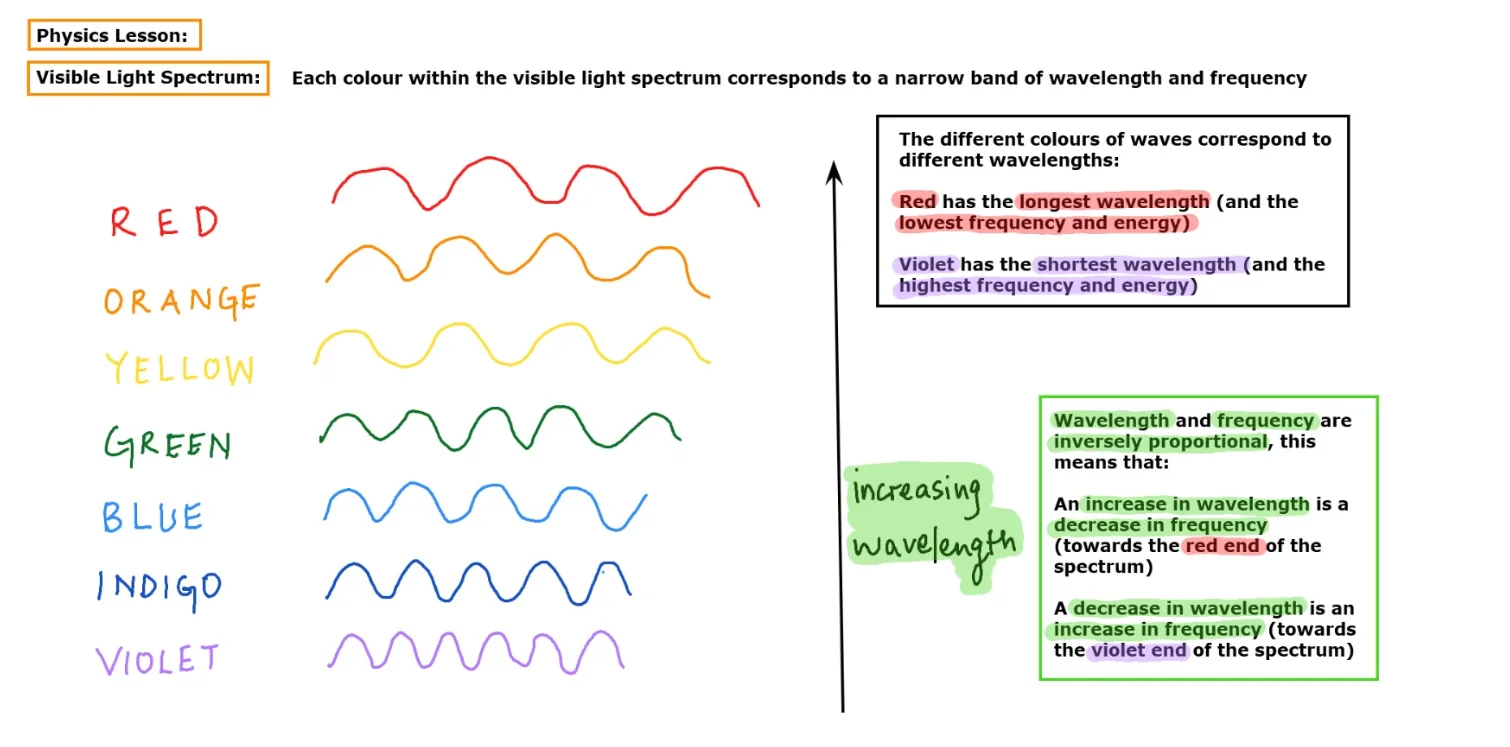
- White light (for example sunlight) is a mixture of all the colours of the visible spectrum.
- The seven traditional colours, in order, are red, orange, yellow, green, blue, indigo, violet (ROYGBIV).
- Each colour is a narrow band of wavelengths and frequencies. Visible light is only a small part of the electromagnetic spectrum.
How do wavelength, frequency and energy change across the spectrum?
- Red has the longest wavelength and the lowest frequency and energy.
- Violet has the shortest wavelength and the highest frequency and energy.
- Wavelength and frequency are inversely proportional: an increase in wavelength means a decrease in frequency (towards the red end); a decrease in wavelength means an increase in frequency (towards the violet end).
- This is because all colours travel at the same speed in a vacuum (3 × 10⁸ m/s), and v = fλ.
| Colour | Wavelength (approx.) | Note |
|---|---|---|
| Red | about 700 nm | longest wavelength, lowest frequency and energy |
| Orange | about 620 nm | |
| Yellow | about 580 nm | |
| Green | about 530 nm | middle of the spectrum |
| Blue | about 470 nm | |
| Indigo | about 440 nm | |
| Violet | about 400 nm | shortest wavelength, highest frequency and energy |
What is dispersion of light?
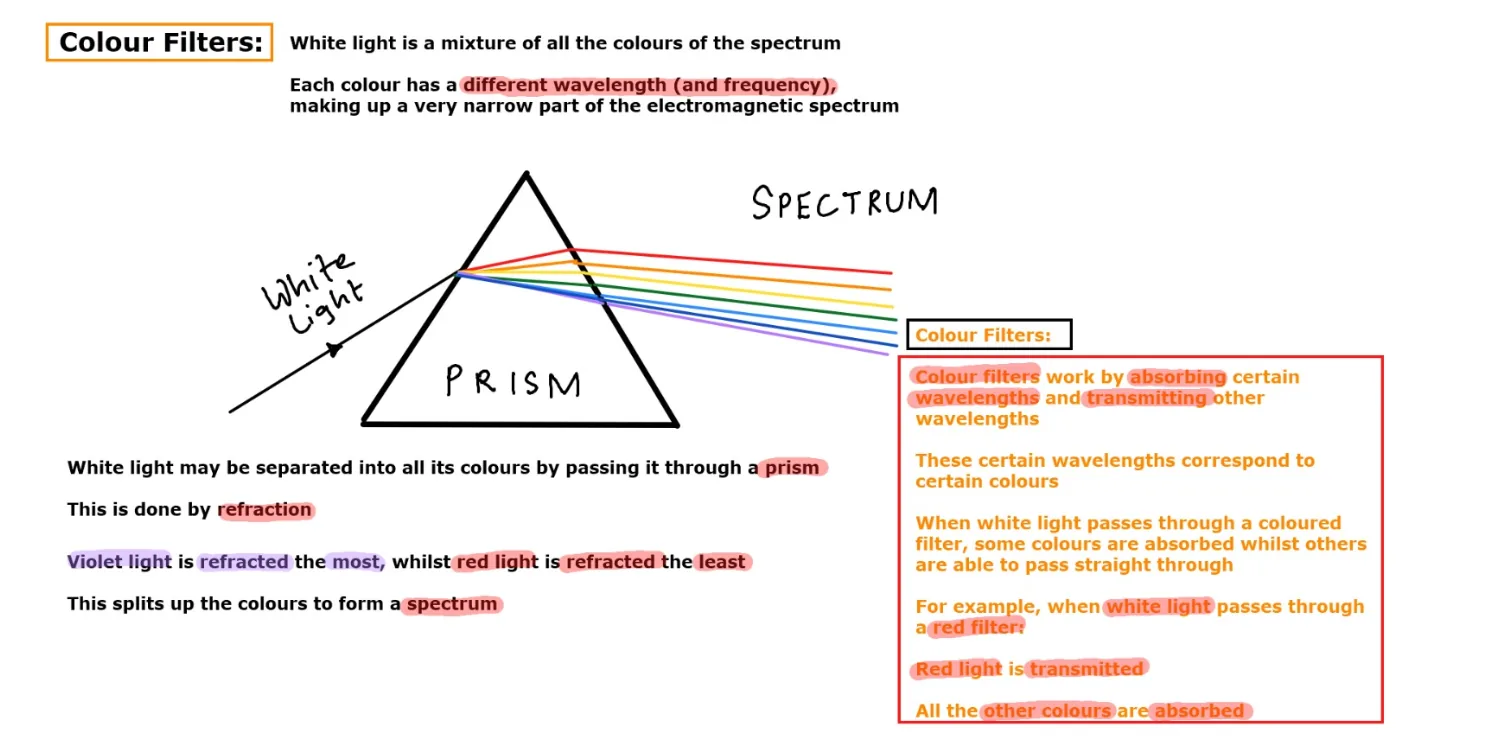
- Dispersion is the splitting of white light into its colours.
- A glass prism does this by refraction: light changes direction as it enters and leaves the glass.
- Each colour is refracted by a different amount: violet is refracted the most, red the least. This spreads the colours out into a spectrum.
- Why? Violet light slows down the most in glass, so it bends the most. Red slows down the least.
- A rainbow forms in the same way: raindrops refract (and reflect) sunlight and disperse it into colours.
White light is refracted as it enters and leaves the prism. Different colours are refracted by different amounts – violet the most and red the least – so the white light is split into a spectrum of colours.
What is monochromatic light? IGCSE Extended
- Monochromatic light is visible light of a single frequency – so it is one colour.
- Example: the light from a laser.
- A prism refracts monochromatic light but cannot split it, because there is only one colour.
How do colour filters work?
- Colour filters work by absorbing certain wavelengths and transmitting (letting through) other wavelengths.
- The colour that is transmitted is the same colour as the filter.
- When white light passes through a red filter: red light is transmitted and all the other colours are absorbed.
- If the light has none of the filter’s colour (for example blue light on a red filter), no light gets through.
- Light leaving a filter is dimmer, because some of the light energy has been absorbed.
Why do objects look coloured? GCSE
- The colour of an opaque object depends on which wavelengths it reflects most strongly. The other wavelengths are absorbed.
- A red object reflects red light and absorbs the rest. A white object reflects all colours equally. A black object absorbs all colours.
- In coloured light, an object can look different: a red object in green light looks black, because there is no red light to reflect.
- Transparent objects transmit light clearly; translucent objects transmit some light but scatter it; opaque objects transmit none.
Interactive colour lab
What colour will you see?
Choose a colour of light and a filter (or an object). The lab shows what comes out and explains why.
Worked examples
Example 1: order of colours
Put these in order of increasing wavelength: green, violet, red, yellow.
- Wavelength increases from violet towards red.
- violet, green, yellow, red
Example 2: one filter
White light passes through a blue filter. What comes out?
- A blue filter transmits blue and absorbs the other colours.
- Blue light (dimmer than the white light).
Example 3: two filters
White light passes through a red filter, then a green filter. What comes out?
- After the red filter, only red light is left.
- The green filter absorbs red light, so no light comes out.
Example 4: coloured object (GCSE)
A white shirt is lit with red light. What colour does it look?
- A white object reflects all colours.
- Only red light is shining on it, so it reflects red: it looks red.
Common mistakes
- Saying a prism adds colour to light. The colours are already in white light; the prism only separates them.
- Saying red is refracted the most. Violet is refracted the most; red the least.
- Mixing up wavelength and frequency. Red = longest wavelength but lowest frequency.
- Saying a filter “changes” or “dyes” the light. It only absorbs some colours and transmits others.
- Saying “reflection” when you mean “refraction”. Dispersion in a prism is caused by refraction.
Practice questions
Try each question first, then open it to check your answer.
Q1. List the seven colours of the visible spectrum in order of increasing frequency.
red, orange, yellow, green, blue, indigo, violet
Q2. Which colour of visible light has the longest wavelength and which has the highest frequency?
Longest wavelength: red. Highest frequency: violet.
Q3. Describe what happens when a narrow beam of white light passes through a glass prism.
The light is refracted as it enters and leaves the prism. Each colour is refracted by a different amount (violet most, red least), so the colours spread out into a spectrum. This is called dispersion.
Q4. What is monochromatic light? (IGCSE Extended)
Light of a single frequency (one colour), for example from a laser.
Q5. White light shines through a green filter. What colour of light comes out, and what happens to the other colours?
Green light is transmitted; all the other colours are absorbed by the filter.
Q6. Blue light shines on a red filter. What do you see on the other side?
No light (darkness). A red filter only transmits red light, so the blue light is absorbed.
Q7. A red football shirt is viewed in green light. What colour does it look? Explain. (GCSE)
It looks black. A red object only reflects red light; there is no red in green light, so all the light is absorbed and none is reflected.
Exam tips
- Learn the order ROYGBIV and practise writing it both ways – by increasing wavelength and by increasing frequency.
- For a prism, always use the words refraction, different amounts and spectrum.
- For filters, use the key words transmits and absorbs.
- For coloured objects, use reflects and absorbs.
Frequently asked questions
What are the seven colours of the visible spectrum in order?
Red, orange, yellow, green, blue, indigo and violet (ROYGBIV). In this order the wavelength decreases and the frequency and energy increase.
Which colour of light has the longest wavelength?
Red light has the longest wavelength (about 700 nm) and the lowest frequency and energy. Violet has the shortest wavelength (about 400 nm) and the highest frequency and energy.
What is dispersion of light?
Dispersion is the splitting of white light into its colours. A glass prism does this by refraction: each colour is refracted by a different amount, so the colours spread out to form a spectrum.
Why is violet light refracted more than red light?
Violet light slows down more than red light when it enters glass, so it changes direction more. Red light slows down the least, so it is refracted the least.
What is monochromatic light?
Monochromatic light is visible light of a single frequency, so it is a single colour. Laser light is an example. It is in the Extended part of Cambridge IGCSE Physics 0625.
How do colour filters work?
A colour filter absorbs some wavelengths of light and transmits others. A red filter transmits red light and absorbs all the other colours, so only red light passes through.
What colour does a red object look in blue light?
It looks black. A red object reflects only red light and absorbs other colours. Blue light contains no red, so nothing is reflected.
Related notes
- Cambridge IGCSE Physics 0625: Waves notes (reflection, refraction and the electromagnetic spectrum)
- Cambridge IGCSE Physics 0625 past papers
- AQA GCSE Physics 8463 past papers
Need help with Physics?
Ms. Asim teaches IGCSE, GCSE and A Level Physics online, 1-to-1, for students in any time zone.
Book a 1-to-1 lesson