
Notes › Biology › IGCSE 0610 › Movement into and out of cells
Cambridge IGCSE Biology 0610: Diffusion, Osmosis and Active Transport Notes
Substances move into and out of cells in three ways. Diffusion and osmosis happen down a concentration gradient and need no extra energy. Active transport moves substances against a concentration gradient and uses energy from respiration. These notes cover movement into and out of cells in the Cambridge IGCSE Biology (0610) syllabus, with diagrams, a diffusion simulation, a quick quiz, the potato osmosis practical, worked examples and exam tips.
Try the diffusion simulationBook a 1-to-1 lessonWritten by Ms. Humaira Asim, a science teacher with 15+ years of teaching experience. Written for the Cambridge IGCSE Biology 0610 syllabus.
Diffusion
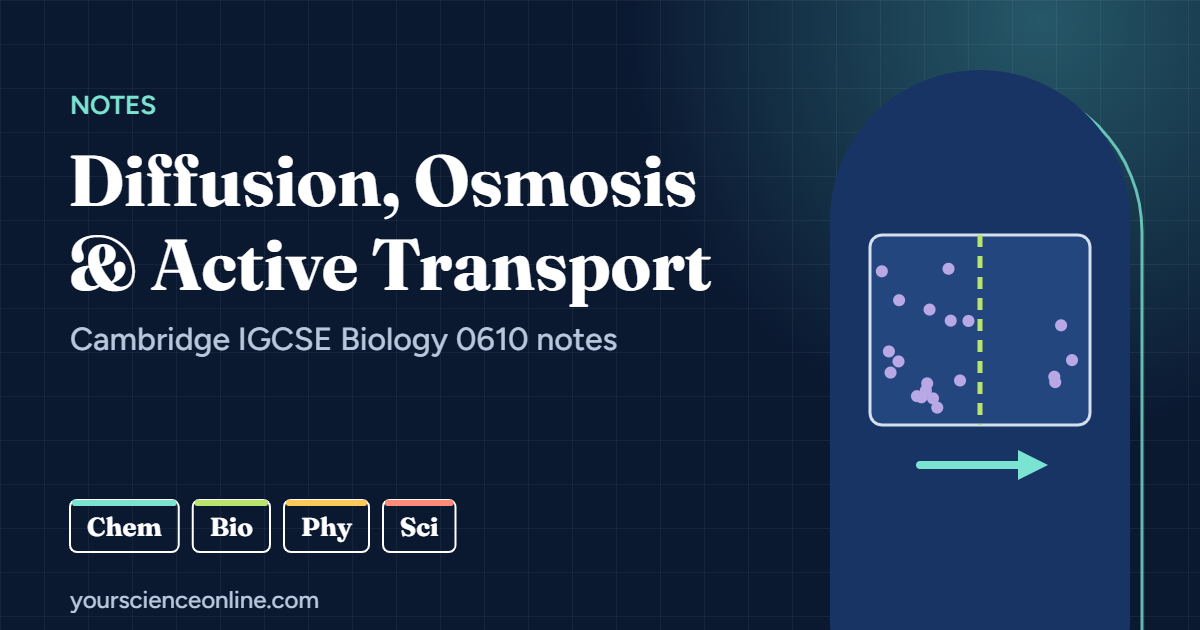
Diffusion is how many substances get into and out of cells. For example, oxygen diffuses from the alveoli into the blood, and carbon dioxide diffuses into leaves for photosynthesis.
What affects the rate of diffusion?
| Factor | Effect | Why |
|---|---|---|
| Surface area | Larger surface area → faster | More particles can cross at the same time |
| Temperature | Higher temperature → faster | Particles have more kinetic energy and move faster |
| Concentration gradient | Steeper gradient → faster | A bigger difference in concentration gives a larger net movement |
| Distance | Shorter distance → faster | Particles have less far to travel, for example across thin cell walls |
Diffusion simulation
Watch diffusion happen
Press Remove the barrier and watch the particles spread out. Then try a higher temperature: the particles move faster, so diffusion happens faster.
Particles on the right: 0%
Osmosis
A partially permeable membrane, such as a cell membrane, lets small molecules like water through but stops larger solute molecules, such as sucrose. Osmosis is a special type of diffusion: the diffusion of water.
In the lab, you can show osmosis with dialysis (Visking) tubing, which is partially permeable. If you fill the tubing with sugar solution and put it in water, water moves in and the tubing swells.
Osmosis in plant cells
- In pure water or a dilute solution: water enters the cell by osmosis. The vacuole swells and the cell contents push against the cell wall. The cell becomes turgid. The cell wall stops it bursting.
- In a more concentrated solution: water leaves the cell. The cell becomes soft, or flaccid, and the plant may wilt.
- In a very concentrated solution: so much water leaves that the cell membrane pulls away from the cell wall. The cell is plasmolysed.
Osmosis in animal cells
Animal cells have no cell wall. In pure water, water enters by osmosis and the cell swells and may burst. In a concentrated solution, water leaves and the cell shrinks. This is why the concentration of blood plasma must be kept steady.
Active transport
Examples: root hair cells take in mineral ions, such as nitrate ions, from the soil, and cells in the small intestine absorb glucose. Cells that do a lot of active transport have many mitochondria to release the energy needed.
Comparing the three processes
| Diffusion | Osmosis | Active transport | |
|---|---|---|---|
| What moves? | Any particles (gases, solutes) | Water only | Particles such as ions and glucose |
| Direction | High → low concentration | Dilute → concentrated solution | Low → high concentration |
| Membrane needed? | No | Yes, partially permeable | Yes, with carrier proteins |
| Energy from respiration? | No | No | Yes |
Quick quiz
Quick quiz: diffusion, osmosis or active transport?
Choose the process for each example. You get feedback straight away.
1. Oxygen moves from the air in the alveoli into the blood.
2. Water moves from the soil into a root hair cell.
3. A root hair cell takes in nitrate ions, even though there are fewer in the soil than in the cell.
4. Carbon dioxide enters a leaf through the stomata.
5. A potato chip gains mass in pure water.
6. Glucose is absorbed from the small intestine when there is less glucose in the gut than in the blood.
7. The smell of perfume spreads across a room.
8. A red blood cell bursts when it is placed in pure water.
The potato osmosis practical
- Cut equal-sized pieces of potato and blot them dry.
- Weigh each piece and record its starting mass.
- Place each piece in a different sucrose solution, for example 0, 0.2, 0.4, 0.6 and 0.8 mol/dm³, for the same time (such as 30 minutes) at the same temperature.
- Remove, blot dry and weigh each piece again.
- Work out the percentage change in mass and plot it against concentration.
Worked examples
Example 1: percentage change (gain)
A potato piece has a mass of 2.50 g. After 30 minutes in pure water, its mass is 2.80 g. Calculate the percentage change in mass and explain it.
- Change = 2.80 − 2.50 = 0.30 g
- % change = 0.30 ÷ 2.50 × 100 = +12.0%
- The water was more dilute than the cell sap, so water entered the cells by osmosis
Example 2: percentage change (loss)
A potato piece goes from 3.20 g to 2.72 g in a concentrated sugar solution. Calculate the percentage change.
- Change = 2.72 − 3.20 = −0.48 g
- % change = −0.48 ÷ 3.20 × 100 = −15.0%
- Water left the cells by osmosis, into the more concentrated solution
Example 3: reading the graph
Use the graph above to estimate the concentration of the solution inside the potato cells.
- Find where the line crosses 0% change
- It crosses at about 0.3 mol/dm³
- The cell sap has about the same concentration as a 0.3 mol/dm³ sucrose solution
Example 4: naming the process
A root hair cell absorbs magnesium ions from soil water, where their concentration is lower than inside the cell. Name the process and explain your answer.
- The ions move from low to high concentration, against the concentration gradient
- This needs energy from respiration
- Active transport
Try it yourself: osmosis practical calculator
In the potato experiment, weigh each piece before and after it sits in a solution. Enter your masses to find the percentage change.
Percentage change in mass
Common mistakes
- Saying “water moves to where there is more water”. Water moves from a dilute solution (more water) to a concentrated solution (less water).
- Forgetting the membrane in osmosis. Always say “through a partially permeable membrane”.
- Saying plant cells burst in water. The cell wall stops them bursting; they become turgid.
- Missing “net” in definitions. Particles move both ways; diffusion is the net movement.
- Forgetting energy in active transport. Say “using energy from respiration”.
Practice questions
Try each question first, then open it to check your answer.
Q1. Define diffusion.
Diffusion is the net movement of particles from a region of higher concentration to a region of lower concentration, down a concentration gradient, as a result of their random movement.
Q2. Give two ways to increase the rate of diffusion.
Any two: increase the surface area, increase the temperature, make the concentration gradient steeper, reduce the distance.
Q3. What is a partially permeable membrane?
A membrane that lets small molecules such as water through, but not larger molecules such as sucrose.
Q4. A plant cell is placed in pure water. Describe and explain what happens.
Water enters by osmosis, the vacuole swells and the cell contents push on the cell wall. The cell becomes turgid, and the cell wall stops it bursting.
Q5. Why does a red blood cell burst in pure water, when a plant cell does not?
Water enters both by osmosis, but the red blood cell has no cell wall to stop it swelling too much.
Q6. A potato piece goes from 4.00 g to 3.60 g. Calculate the percentage change in mass.
(3.60 − 4.00) ÷ 4.00 × 100 = −10%
Q7. Why do root hair cells have many mitochondria?
They carry out active transport to absorb mineral ions, which needs energy from respiration, which happens in mitochondria.
Q8. Give one similarity and one difference between diffusion and active transport.
Similarity: both move particles (for example into or out of cells). Difference: diffusion is down a concentration gradient with no energy needed; active transport is against the gradient and needs energy from respiration.
Exam tips
- Learn the three definitions word for word. They are often worth easy marks.
- Use the key phrases: concentration gradient, partially permeable membrane, energy from respiration.
- In practical questions, explain why you blot the potato dry (to remove surface water so only water inside the cells is measured) and why you use percentage change.
- When you describe a graph, quote values, such as “no change at about 0.3 mol/dm³”.
Frequently asked questions
Is osmosis a type of diffusion?
Yes. Osmosis is the diffusion of water molecules through a partially permeable membrane.
Does diffusion need energy?
No. Diffusion uses the kinetic energy of the moving particles, so no energy from respiration is needed. Active transport does need energy.
What is the difference between turgid and flaccid?
A turgid plant cell is swollen and firm because water has entered and the contents push on the cell wall. A flaccid cell has lost water and is soft.
Are these notes suitable for Year 7, Year 8 or KS3 science?
The diffusion section and the simulation suit Year 7 to 9 (KS3) science. Osmosis and active transport are usually taught at GCSE and IGCSE.
Need help with Biology?
Ms. Asim teaches IGCSE, GCSE and A Level Biology online, 1-to-1, for students in any time zone.
Book a 1-to-1 lessonTry the Biology calculatorRelated notes: Cells and cell structure. This topic is also part of GCSE and IGCSE Combined Science: see all Combined Science notes. More Biology notes: Biology notes topic list. These notes follow the Cambridge IGCSE Biology 0610 syllabus. Always check the current syllabus on the Cambridge International website.