
Notes › Chemistry › IGCSE 0620 › Group I: The Alkali Metals
Cambridge IGCSE Chemistry 0620: Group I Alkali Metals Notes
The alkali metals are the elements in Group I of the Periodic Table. For IGCSE you need to know their physical properties, how lithium, sodium and potassium react with water, the trends down the group and how to predict the properties of rubidium, caesium and francium. These notes follow the Cambridge IGCSE Chemistry (0620) syllabus and also suit GCSE, with equations, observations, exam tips and FAQs.
Start with the basicsFree worksheetWritten by Ms. Humaira Asim, a science teacher with 15+ years of teaching experience. Written for the Cambridge IGCSE Chemistry 0620 syllabus (2026–2028).
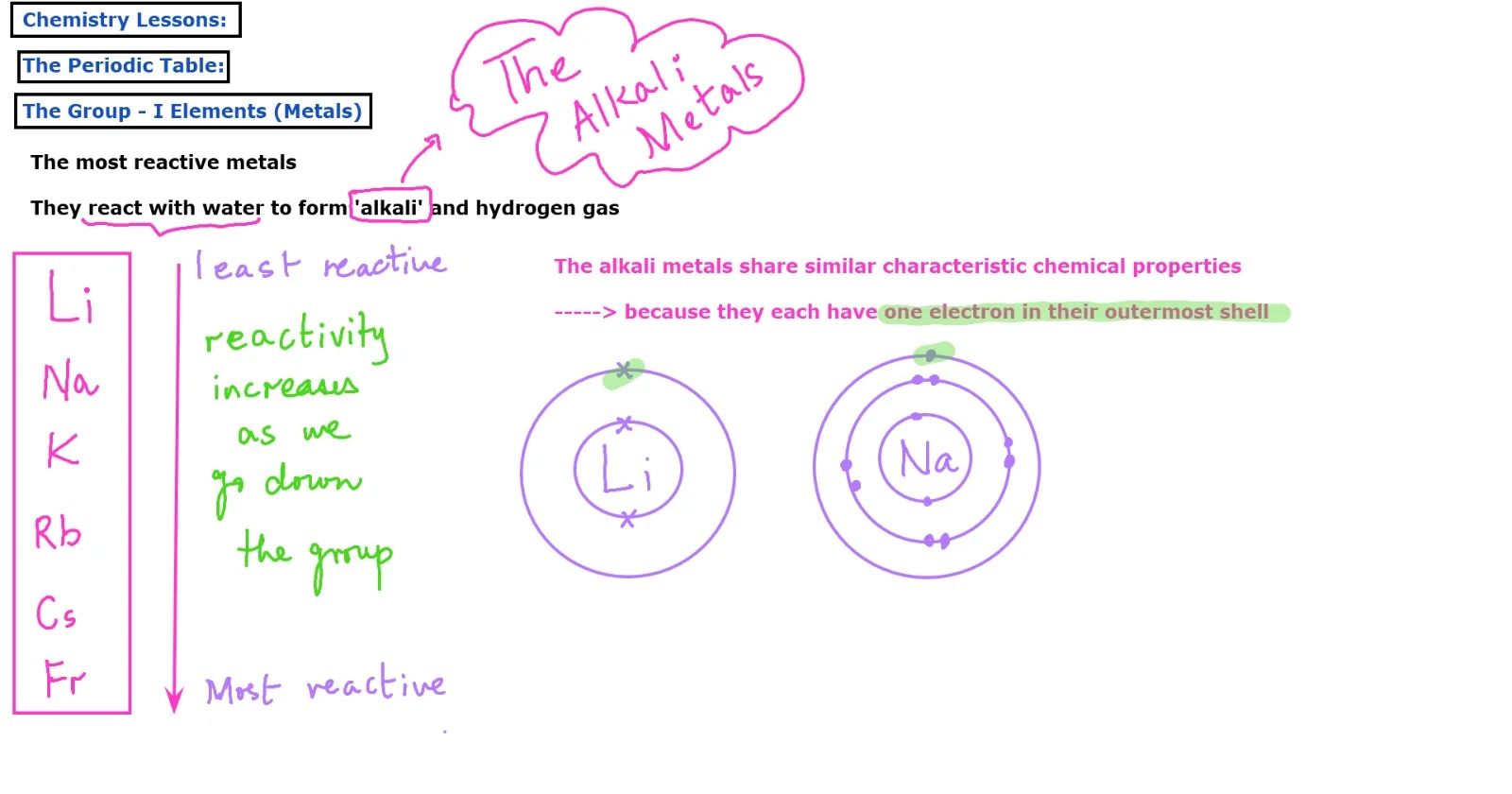
Quick answer: Group I metals (Li, Na, K, Rb, Cs, Fr) all have one electron in their outer shell, so they have similar chemical properties. They react with water to form an alkali (a metal hydroxide) and hydrogen. Going down the group, reactivity increases, melting point decreases and density generally increases.
From my lesson board
These are my own whiteboard notes from a live Group I lesson. Tap a board to open it full size. The typed notes below explain each part step by step.
The full balanced equations are in the reactions with water section.
What are the alkali metals?
- The alkali metals are the elements in Group I: lithium (Li), sodium (Na), potassium (K), rubidium (Rb), caesium (Cs) and francium (Fr).
- They are the most reactive metals in the Periodic Table.
- They are called alkali metals because they react with water to form an alkaline solution and hydrogen gas.
- Elements in the Periodic Table are arranged in order of increasing proton (atomic) number. Vertical columns are groups; horizontal rows are periods.
Why do alkali metals have similar chemical properties?
All Group I atoms have one electron in their outer shell (shown in orange below). When they react, each atom loses this one electron to form an ion with a 1+ charge, for example Na → Na+ + e−. Because they all react in the same way, they have similar chemical properties.
- The group number tells you the number of outer electrons: Group I = 1 outer electron.
- The period number tells you the number of occupied electron shells: potassium (2,8,8,1) is in Period 4.
What are the physical properties of the alkali metals?
- Soft: they can be cut with a knife, and get softer down the group.
- Shiny when freshly cut, but quickly go dull as they react with oxygen in the air.
- Low density: lithium, sodium and potassium float on water.
- Low melting points compared with most metals.
- Good conductors of heat and electricity.
- Stored under oil to stop them reacting with air and water.
| Element | Melting point (°C) | Density (g/cm3) |
|---|---|---|
| Lithium | 181 | 0.53 |
| Sodium | 98 | 0.97 |
| Potassium | 63 | 0.86 |
| Rubidium | 39 | 1.53 |
| Caesium | 29 | 1.93 |
Trends down the group: melting point decreases; density generally increases (potassium is the exception, as it is less dense than sodium).
How do the alkali metals react with water?
Word and balanced symbol equations
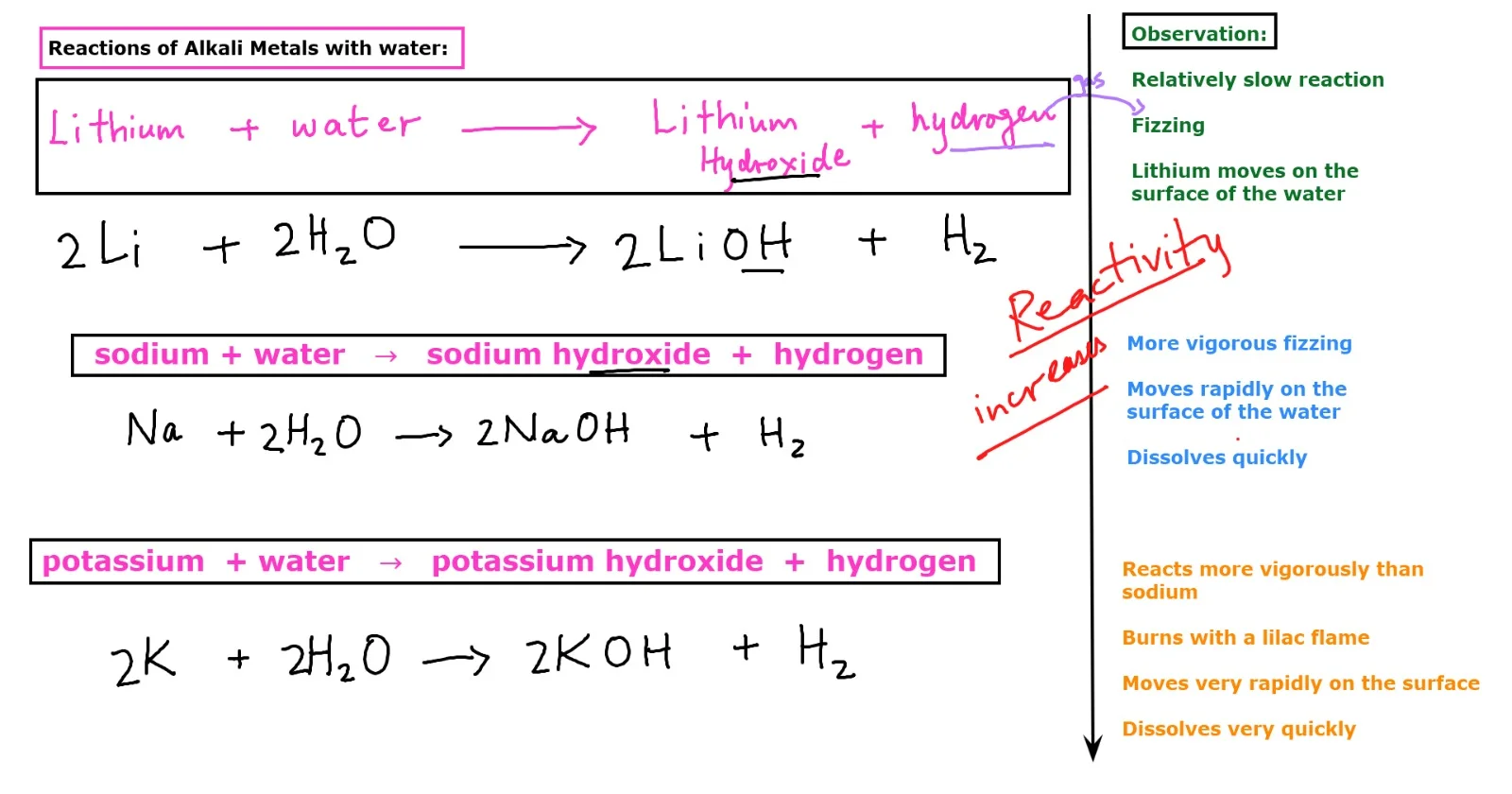
- lithium + water → lithium hydroxide + hydrogen
2Li(s) + 2H2O(l) → 2LiOH(aq) + H2(g) - sodium + water → sodium hydroxide + hydrogen
2Na(s) + 2H2O(l) → 2NaOH(aq) + H2(g) - potassium + water → potassium hydroxide + hydrogen
2K(s) + 2H2O(l) → 2KOH(aq) + H2(g)
| Metal | Observations with cold water |
|---|---|
| Lithium | Floats; fizzes steadily; moves slowly on the surface; gradually gets smaller. Relatively slow reaction. |
| Sodium | Floats; fizzes vigorously; melts into a silver ball (the reaction is exothermic); moves rapidly on the surface; dissolves quickly. |
| Potassium | Reacts more vigorously than sodium; melts; the hydrogen catches fire and burns with a lilac flame; moves very rapidly; may spit or crackle; dissolves very quickly. |
Test for hydrogen: hold a lighted splint at the mouth of the tube: hydrogen burns with a squeaky pop.
Why does reactivity increase down Group I?
- Going down the group, atoms have more electron shells, so they are larger.
- The outer electron is further from the nucleus and there is more shielding from inner shells.
- So the attraction between the nucleus and the outer electron is weaker.
- The outer electron is lost more easily, so the metal reacts more readily.
Losing electrons is oxidation (OIL RIG: Oxidation Is Loss, Reduction Is Gain). Example half equation: K → K+ + e−.
How do alkali metals react with oxygen and chlorine?
- Oxygen: a freshly cut surface goes dull as the metal reacts with oxygen in the air to form a metal oxide.
4Na(s) + O2(g) → 2Na2O(s) - Chlorine: hot sodium burns in chlorine to form a white solid, sodium chloride.
2Na(s) + Cl2(g) → 2NaCl(s) - Group I chlorides are white ionic solids that dissolve in water to form neutral solutions (pH 7).
How do you predict the properties of rubidium, caesium and francium?
Use the trends. Elements lower in Group I will be softer, have lower melting points, be denser and be more reactive. Their compounds have the same type of formula as sodium’s:
| Element | Hydroxide | Chloride | Oxide | Reaction with water |
|---|---|---|---|---|
| Sodium | NaOH | NaCl | Na2O | Vigorous |
| Rubidium | RbOH | RbCl | Rb2O | Violent |
| Caesium | CsOH | CsCl | Cs2O | Explosive |
| Francium | FrOH | FrCl | Fr2O | Predicted most violent |
Francium is radioactive and extremely rare, so its reactions are almost never studied.
What are the top exam tips for Group I?
- Write observations (fizzing, floats, moves, melts, dissolves, lilac flame), not conclusions like “hydrogen is made”.
- Balance carefully: 2Na + 2H2O → 2NaOH + H2. A common mistake is writing Na instead of 2Na.
- When explaining reactivity, always talk about the outer electron: distance from the nucleus, shielding and attraction.
- “Same group” alone is not enough to explain similar properties: say they have one outer electron.
- Potassium breaks the density trend: check data tables carefully.
Where can I practise Group I questions?
Try our free printable GCSE and IGCSE Alkali Metals worksheet (77 marks, with a separate mark scheme). It covers the Periodic Table, electronic structure, reactions with water, oxygen and chlorine, data trends and predicting francium. You can also practise with real exam questions on our IGCSE Chemistry 0620 past papers page.
Frequently asked questions
What are the alkali metals?
The alkali metals are the Group I elements: lithium, sodium, potassium, rubidium, caesium and francium. They are called alkali metals because they react with water to form an alkaline solution (a metal hydroxide) and hydrogen gas.
Why do alkali metals have similar chemical properties?
All Group I atoms have one electron in their outer shell. They react in the same way by losing this one electron to form an ion with a 1+ charge, such as Na+.
Why does reactivity increase down Group I?
Going down the group the atoms get bigger and have more electron shells. The outer electron is further from the nucleus and more shielded by inner shells, so it is attracted less strongly and is lost more easily.
What is the equation for sodium and water?
Sodium + water → sodium hydroxide + hydrogen. The balanced symbol equation is 2Na(s) + 2H2O(l) → 2NaOH(aq) + H2(g).
Why are alkali metals stored under oil?
They react quickly with oxygen and water vapour in the air. Storing them under oil keeps air and water away from the metal.
What colour flame does potassium burn with?
Potassium burns with a lilac flame when it reacts with water. In flame tests lithium gives red, sodium gives yellow and potassium gives lilac.
Stuck on Group I?
Get personal help with Ms. Asim in a 1-to-1 online lesson, scheduled around your time zone.
Book an appointmentMore Chemistry notesRelated: Energetics notes · Rates of reaction notes · Organic chemistry notes · The mole and stoichiometry notes. This is an independent study resource. It is not affiliated with or endorsed by Cambridge University Press & Assessment. Always check the latest official syllabus for your exam series.