
Notes › Physics › IGCSE 0625 › Forces and vectors
Cambridge IGCSE Physics 0625: Forces, Resultant Force and Vectors Notes
A force is a push or a pull, measured in newtons (N). Forces can change an object’s speed, direction or shape. These notes cover forces in the Cambridge IGCSE Physics (0625) syllabus: scalars and vectors, free-body diagrams, resultant force, Newton’s first law, F = ma, weight, adding vectors and Hooke’s law, with diagrams, worked examples, practice questions and exam tips.
Try the forces calculatorBook a 1-to-1 lessonWritten by Ms. Humaira Asim, a science teacher with 15+ years of teaching experience. Written for the Cambridge IGCSE Physics 0625 syllabus.
What is a force?
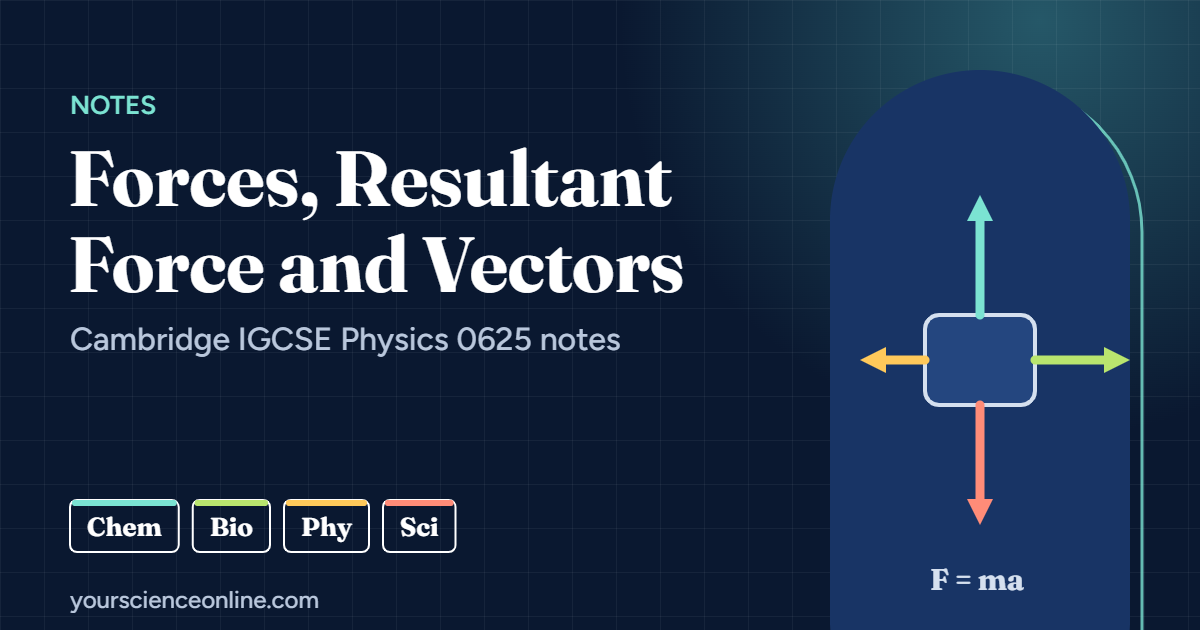
A force is a push or a pull that acts on an object. Forces are measured in newtons (N). A force can:
- make a stationary object start to move
- make a moving object speed up or slow down
- change the direction an object is moving in
- change the shape of an object (stretch, squash, bend or twist it)
Scalars and vectors
A scalar quantity has size (magnitude) only. A vector quantity has both size and direction. Force is a vector, so you must always think about which way it acts.
| Scalars (size only) | Vectors (size and direction) |
|---|---|
| distance | displacement |
| speed | velocity |
| time | acceleration |
| mass | force (including weight) |
| energy | momentum |
| temperature | gravitational field strength |
Types of force and free-body diagrams
| Force | What it is |
|---|---|
| Weight | The pull of gravity on an object’s mass, acting downwards |
| Normal contact force | The push from a surface on an object resting on it, acting at 90° to the surface |
| Friction | A force that opposes motion between two surfaces in contact |
| Air resistance (drag) | Friction from air or water acting on a moving object; it increases with speed |
| Tension | The pull in a stretched string, rope or cable |
| Thrust / driving force | The forward force from an engine, a motor or a person pushing |
| Upthrust | The upward push of a liquid or gas on an object in it |
Resultant force
When several forces act on an object, they can be replaced by a single force with the same effect. This is the resultant force.
- Forces in the same direction: add them.
- Forces in opposite directions: subtract the smaller from the larger. The resultant acts in the direction of the larger force.
Balanced forces and Newton’s first law
If the forces on an object are balanced, the resultant force is zero. Newton’s first law says that an object stays at rest, or keeps moving at a constant speed in a straight line, unless a resultant force acts on it.
| Resultant force | Effect on the object |
|---|---|
| Zero (balanced) | Stays at rest, or keeps moving at constant velocity |
| Not zero (unbalanced) | Accelerates in the direction of the resultant force: it speeds up, slows down or changes direction |
Force, mass and acceleration (F = ma)
A bigger resultant force gives a bigger acceleration. A bigger mass needs a bigger force for the same acceleration. Always use the resultant force in this equation, not just one of the forces.
Rearranged: a = F ÷ m and m = F ÷ a. One newton is the force that gives a mass of 1 kg an acceleration of 1 m/s2.
Weight
Mass is the amount of matter in an object, measured in kg. Weight is the gravitational force on that mass, measured in N.
Your mass is the same everywhere, but your weight changes if g changes. On the Moon, g is about 1.6 N/kg, so you would weigh much less. Weight is measured with a force meter (newton meter).
Adding perpendicular vectors (Extended)
When two forces act at 90° to each other, draw them tip-to-tail. The resultant is the arrow from the start of the first force to the end of the second. You can find it by scale drawing, or by calculation using Pythagoras’ theorem.
Scale drawing method: choose a scale (for example 1 cm = 5 N), draw each vector carefully with a ruler and protractor, measure the length of the resultant, then convert it back to newtons using your scale.
Springs and Hooke’s law
When you hang a load on a spring, it stretches. The extension is the increase in length: extension = stretched length − original length.
For a spring, extension is directly proportional to the load, up to a point called the limit of proportionality. This is Hooke’s law. A graph of extension against load is a straight line through the origin up to this point.
A stiff spring has a large spring constant. Beyond the limit of proportionality, the graph curves and the spring may not return to its original length when the load is removed.
Worked examples
Example 1: resultant force along a line
A box is pushed with a force of 50 N to the right. Friction of 20 N acts to the left. Find the resultant force.
- The forces are in opposite directions, so subtract: 50 − 20 = 30 N
- The larger force is to the right
- Resultant force = 30 N to the right
Example 2: using F = ma
A car of mass 1200 kg has a resultant force of 3000 N acting on it. Calculate its acceleration.
- a = F ÷ m
- = 3000 ÷ 1200
- = 2.5 m/s2
Example 3: finding the force
A 0.50 kg ball accelerates at 12 m/s2 when it is kicked. Calculate the resultant force on it.
- F = ma
- = 0.50 × 12
- = 6.0 N
Example 4: two forces, then F = ma
A go-kart of mass 300 kg has a driving force of 800 N. Friction and air resistance total 200 N. Calculate its acceleration.
- Resultant force = 800 − 200 = 600 N forwards
- a = F ÷ m = 600 ÷ 300
- = 2.0 m/s2
Example 5: weight
A student has a mass of 65 kg. Calculate her weight on Earth (g = 9.8 N/kg).
- W = mg
- = 65 × 9.8 = 637 N
- = 640 N (2 s.f.)
Example 6: perpendicular forces (Extended)
A force of 30 N acts east and a force of 40 N acts north on the same object. Find the size and direction of the resultant force.
- Resultant = √(302 + 402) = √(900 + 1600) = √2500
- = 50 N
- tan θ = 40 ÷ 30 = 1.33, so θ = 53°
- Direction: 53° north of east
Example 7: spring constant (Extended)
A load of 4.0 N stretches a spring by 8.0 cm. Calculate the spring constant, then the extension for a 6.0 N load (within the limit of proportionality).
- Convert: 8.0 cm = 0.080 m
- k = F ÷ x = 4.0 ÷ 0.080 = 50 N/m
- x = F ÷ k = 6.0 ÷ 50 = 0.12 m (12 cm)
Common mistakes
- Using one force in F = ma. Always work out the resultant force first.
- Mixing up mass and weight. Mass is in kg and does not change. Weight is a force in N.
- Thinking a moving object needs a resultant force. At constant velocity, the forces are balanced.
- Adding perpendicular forces like numbers. 30 N and 40 N at 90° give 50 N, not 70 N.
- Using length instead of extension. Subtract the original length first.
- Forgetting units. Convert cm to m before using k = F ÷ x if k is in N/m.
Try it yourself: forces calculator
Change the numbers and check your own answers to the practice questions.
Resultant force
F = ma
Fill in any two boxes and leave the third empty.
Weight W = mg
On the Moon, try g = 1.6 N/kg.
Practice questions
Try each question first, then open it to check your answer.
Q1. Two forces of 15 N act on a box in opposite directions. What is the resultant force, and what happens to the box?
The resultant force is 0 N. The forces are balanced, so the box stays at rest, or keeps moving at a constant velocity if it was already moving.
Q2. A boat’s engine gives a thrust of 500 N. Water resistance is 350 N. Find the resultant force.
500 − 350 = 150 N forwards
Q3. A resultant force of 5.0 N acts on a 2.0 kg trolley. Calculate its acceleration.
a = 5.0 ÷ 2.0 = 2.5 m/s2
Q4. What resultant force is needed to give a 1500 kg car an acceleration of 3.0 m/s2?
F = 1500 × 3.0 = 4500 N
Q5. Calculate the weight of a 2.5 kg bag of rice on Earth (g = 9.8 N/kg).
W = 2.5 × 9.8 = 24.5 N (25 N to 2 s.f.)
Q6. Forces of 5.0 N and 12 N act at right angles to each other. Find the size of the resultant force.
√(5.02 + 122) = √169 = 13 N
Q7. A spring has a spring constant of 25 N/m. Calculate its extension when a 3.0 N load is hung on it.
x = F ÷ k = 3.0 ÷ 25 = 0.12 m (12 cm)
Q8. A cyclist pedals so that the forward force equals the total resistive force. Describe and explain her motion.
The resultant force is zero, so by Newton’s first law she moves at a constant speed in a straight line. She does not speed up or slow down.
Exam tips
- Draw a quick free-body diagram before any force calculation. It helps you see which forces to add or subtract.
- Give the direction with every resultant force or vector answer, for example “30 N to the right”.
- Write the equation, substitute, then give the answer with a unit. Method marks are often available.
- In scale drawings, state your scale and use a sharp pencil. Examiners allow a small tolerance on measured answers.
Frequently asked questions
What is the difference between mass and weight?
Mass is the amount of matter in an object, measured in kilograms. Weight is the force of gravity on that mass, measured in newtons. W = mg.
Is force a scalar or a vector?
Force is a vector, because it has both size and direction.
What is the unit of force?
The newton (N). One newton gives a 1 kg mass an acceleration of 1 m/s2.
Need help with forces?
Ms. Asim teaches IGCSE, GCSE and A Level Physics online, 1-to-1, for students in any time zone.
Book a 1-to-1 lessonTry the Physics calculatorThis topic is also part of GCSE and IGCSE Combined Science: see all Combined Science notes. Related notes: Speed, velocity and acceleration · Physics notes topic list. These notes follow the Cambridge IGCSE Physics 0625 syllabus. Always check the current syllabus on the Cambridge International website.