
Home › Printables › Christmas Science › Ages 12–16
Christmas science activities for teens: free printable pack (ages 12–16)
Christmas science activities for high school and middle school students in one free 16-page printable pack. It has a 24-day science advent calendar, five real investigations with variables worksheets built in, exam-style questions on the science of Christmas, puzzles, calculations and a full answer key. Written by Ms. Humaira Asim, a science teacher with 15+ years of teaching experience.
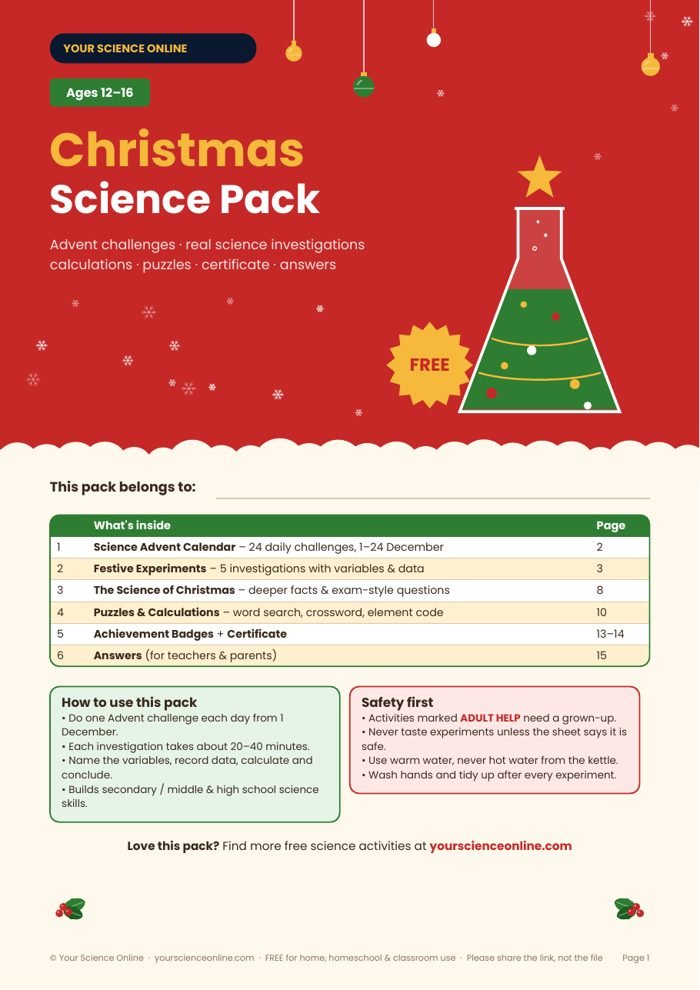
Download the Christmas Science Pack (Ages 12–16)
16 pages · free PDF · answers and mark scheme included · choose your paper size
Five Christmas science experiments for middle school and high school
| Investigation | Topic | Independent variable | Dependent variable |
|---|---|---|---|
| Fizzy Tablet Race | Chemistry: rates of reaction | Temperature of water | Time to stop fizzing |
| Endothermic Snow | Chemistry: energy changes | Amount of baking soda | Temperature change |
| Hot Chocolate Insulation | Physics: energy transfer | Insulating material | Temperature drop in 10 minutes |
| Cupcake Case Parachutes | Physics: forces and terminal velocity | Number of cases | Time to fall 2.0 m |
| Christmas Chromatography | Chemistry: separating mixtures | Type of ink | Number and position of spots (Rf) |
Each sheet leaves the variables boxes blank for students to fill in. The table above is for teachers and parents.
A Christmas science variables worksheet in every investigation
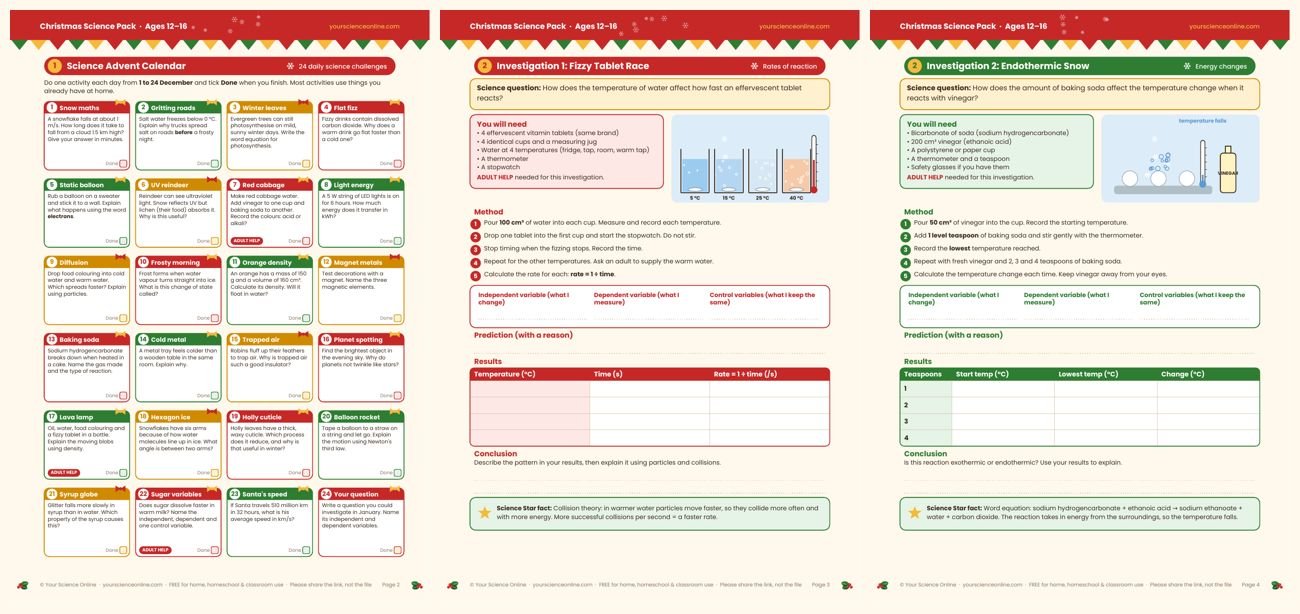
Every investigation follows the same scientific method: science question, method, independent, dependent and control variables, a prediction with a reason, a results table, a calculation (rate, temperature change, mean, speed or Rf value) and a conclusion. That makes the pack a festive way to review variables and fair tests before the Christmas break.
Christmas chemistry activities, Christmas physics and biology
- Chemistry: collision theory with fizzy tablets, an endothermic reaction with a word equation, chromatography with Rf values, flame colours in fireworks, and an element code using atomic numbers.
- Physics: terminal velocity, insulation and energy transfer, efficiency of fairy lights, specific heat capacity of mince pie filling, and energy in kWh.
- Biology: reindeer that see ultraviolet light, the gene that makes some people hate sprouts, transpiration in Christmas trees, and photosynthesis in winter.
A science advent calendar for teens
Most science advent calendars are made for young children. This one has 24 short challenges for older students, such as calculating Santa’s average speed in km/s, the density of an orange, the energy used by LED lights in kWh, and explaining frost formation, diffusion and static electricity.
What’s inside
- Page 2: Science advent calendar (24 challenges)
- Pages 3–7: five investigations
- Pages 8–9: the Science of Christmas with exam-style questions and marks
- Pages 10–12: word search, crossword, element code and Christmas calculations
- Pages 13–14: achievement badges and certificate
- Pages 15–16: answers and mark scheme
Frequently asked questions
Is this Christmas science pack for teens free?
Yes. It is a free 16-page PDF with no sign-up, for home, homeschool and single-classroom use.
Which grades is it for?
It is written for ages 12 to 16: middle school and high school, or lower and upper secondary (roughly grades 6–10 or Years 7–11). It is not tied to any one exam board.
Does it practise variables?
Yes. All five investigations ask students to name the independent, dependent and control variables, make a prediction with a reason, record results and write a conclusion. Advent challenge 22 and 24 also practise variables.
What equipment is needed?
Mostly household items: cups, effervescent vitamin tablets, baking soda, vinegar, mugs, foil, cupcake cases, felt-tip pens and filter paper. A thermometer and a stopwatch (a phone works) are useful.
Are answers included?
Yes. Pages 15 and 16 include answers to all 24 advent challenges, expected results for each investigation, a mark scheme for the exam-style questions, and all puzzle and calculation answers.
Teaching younger children too?
The Ages 8–11 pack has the same Christmas theme with simpler hands-on experiments, puzzles and colouring badges.
See the kids’ pack