
Home › Teacher Resources › Lower Secondary › Year 8 › Acids, alkalis and neutralisation
Year 8 Acids and Alkalis Worksheets: Part 1 and Part 2 (with Mark Schemes)
Quick answer: two free, printable Year 8 acids and alkalis worksheets, each with its own mark scheme. Part 1 covers acids, alkalis and neutralisation; Part 2 covers the pH scale, strong and weak acids, naming salts, word equations and gas tests.
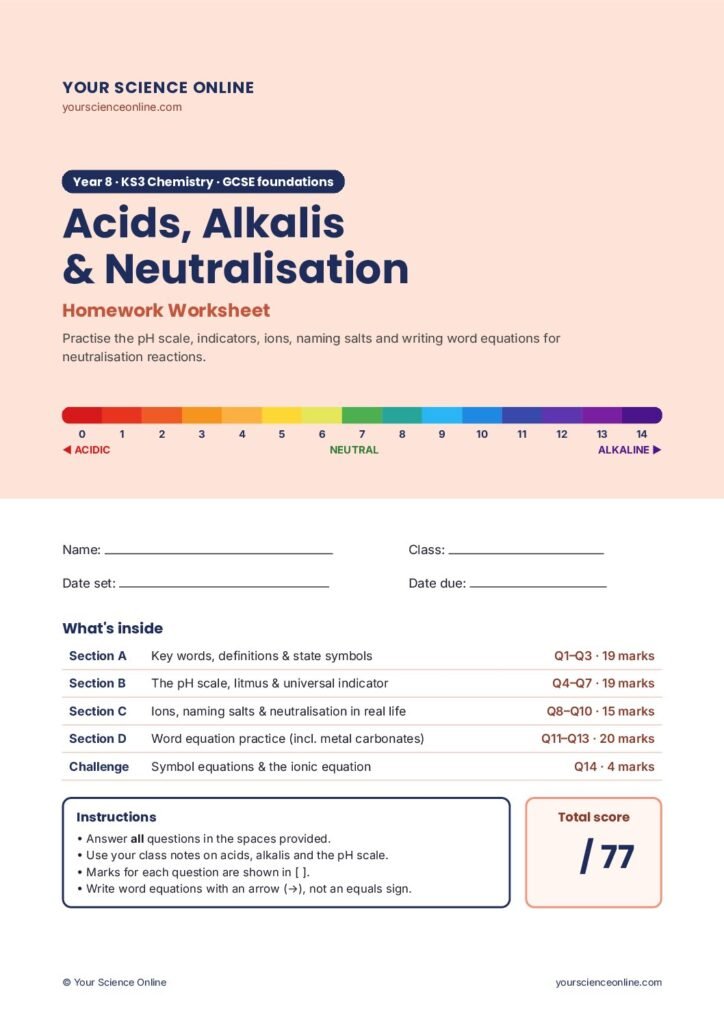
A printable Year 8 (KS3) chemistry homework worksheet on acids, alkalis and neutralisation that builds strong GCSE foundations. Students practise key words and state symbols, the pH scale, litmus and universal indicator, ions, naming salts, and writing word equations for neutralisation, including reactions with metal carbonates. A challenge question introduces symbol and ionic equations. A full mark scheme with marking guidance is included.
- Year 8
- KS3 Chemistry
- GCSE foundations
- Part 1: 77 marks
- Part 2: 75 marks
- Free PDF
Part 1: Acids, Alkalis and Neutralisation (77 marks)
What Part 1 covers
| Section | Topic | What students do | Marks |
|---|---|---|---|
| A | Key words, definitions and state symbols | Gap fill, state symbols (s), (l), (g), (aq), true or false | 19 |
| B | The pH scale, litmus and universal indicator | Reading the pH scale, classifying substances, indicator colours | 19 |
| C | Ions, naming salts and neutralisation in real life | H⁺ and OH⁻ ions, naming salts, everyday neutralisation | 15 |
| D | Word equation practice | Neutralisation word equations, including metal carbonates | 20 |
| Challenge | Symbol equations and the ionic equation | Balanced symbol equation and H⁺ + OH⁻ → H₂O | 4 |
| Total | 77 | ||
Part 2: Acids, Alkalis and Salts (75 marks)
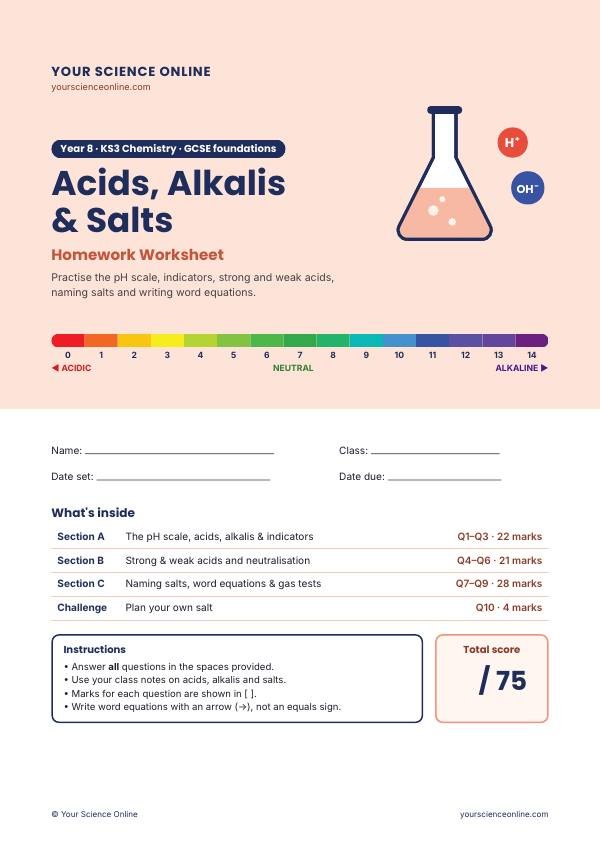
Part 2 is a homework worksheet that goes a step further. Students use the pH scale and indicators, compare strong and weak acids, explain neutralisation with H⁺ and OH⁻ ions, name salts, complete word equations and recall the tests for hydrogen and carbon dioxide. A challenge question asks them to plan how to make a salt.
What Part 2 covers
| Section | Topic | Marks |
|---|---|---|
| A | The pH scale, acids, alkalis and indicators | 22 |
| B | Strong and weak acids, and neutralisation | 21 |
| C | Naming salts, word equations and gas tests | 28 |
| Challenge | Plan your own salt | 4 |
| Total | 75 | |
Skills students practise
- Using the pH scale to describe acids, alkalis and neutral solutions
- Recalling litmus and universal indicator colours
- Naming salts from the acid used (chlorides, sulfates, nitrates)
- Writing word equations for neutralisation, including metal carbonates
- Stretch: symbol equations and the ionic equation for neutralisation
How to use it
- Download and print the worksheet, single- or double-sided.
- Set it as classwork, homework or a revision task.
- Use the mark scheme to mark it yourself, or let students self-assess or peer-assess.
Frequently asked questions
Does this worksheet come with answers?
Yes. A separate mark scheme (3 pages, A4) gives the answers and marking guidance for all 77 marks.
Is the worksheet free?
Yes. Both PDFs are free to download, print and use with your own students.
Which level is it for?
It is written for Year 8, KS3. Always check it against your own scheme of work or exam specification.
What is the difference between Part 1 and Part 2?
Part 1 (77 marks) covers key words, state symbols, the pH scale, indicators, ions and neutralisation word equations. Part 2 (75 marks) adds strong and weak acids, naming salts from different acids, gas tests and a plan-your-own-salt challenge. Each part has its own mark scheme.
More resources: Chemistry notes topic list · Chemistry calculators · More Year 8 worksheets
Need help teaching this topic?
Ms. Humaira Asim, a science teacher with 15+ years of experience, offers 1-to-1 online science lessons for students in any time zone.
Book a 1-to-1 lesson