
Notes › Physics › GCSE & IGCSE › Momentum
Momentum: p = mv, Conservation of Momentum and Impulse (GCSE & IGCSE Physics)
Quick answer: Momentum = mass × velocity (p = mv), measured in kg m/s. It is a vector, so direction matters: momentum in the opposite direction is negative, and an object at rest has no momentum. In a closed system, total momentum before an event = total momentum after (conservation of momentum). Force = change in momentum ÷ time, so a longer impact time means a smaller force.
What momentum is, how to use p = mv, why momentum can be negative, conservation of momentum in collisions and explosions, and how force, impulse and car safety features link to momentum. Written from my own lesson boards for GCSE Physics (Higher tier) and Cambridge IGCSE Physics 0625 (Extended), with a momentum calculator, worked examples and exam-style questions.
Try the momentum calculatorBook a 1-to-1 lessonWritten by Ms. Humaira Asim, a science teacher with 15+ years of teaching experience. Checked against the AQA GCSE Physics (8463) and Cambridge IGCSE Physics 0625 specifications.
- Both: p = mv, momentum as a vector, conservation of momentum in a closed system.
- Cambridge IGCSE 0625 (Extended): impulse = FΔt = Δ(mv), and resultant force = change in momentum ÷ time.
- AQA GCSE: conservation is in Combined Science (Higher). Force = change in momentum ÷ time and safety features (air bags, seat belts, crumple zones, helmets, cushioned surfaces) are Physics only.
What is momentum?
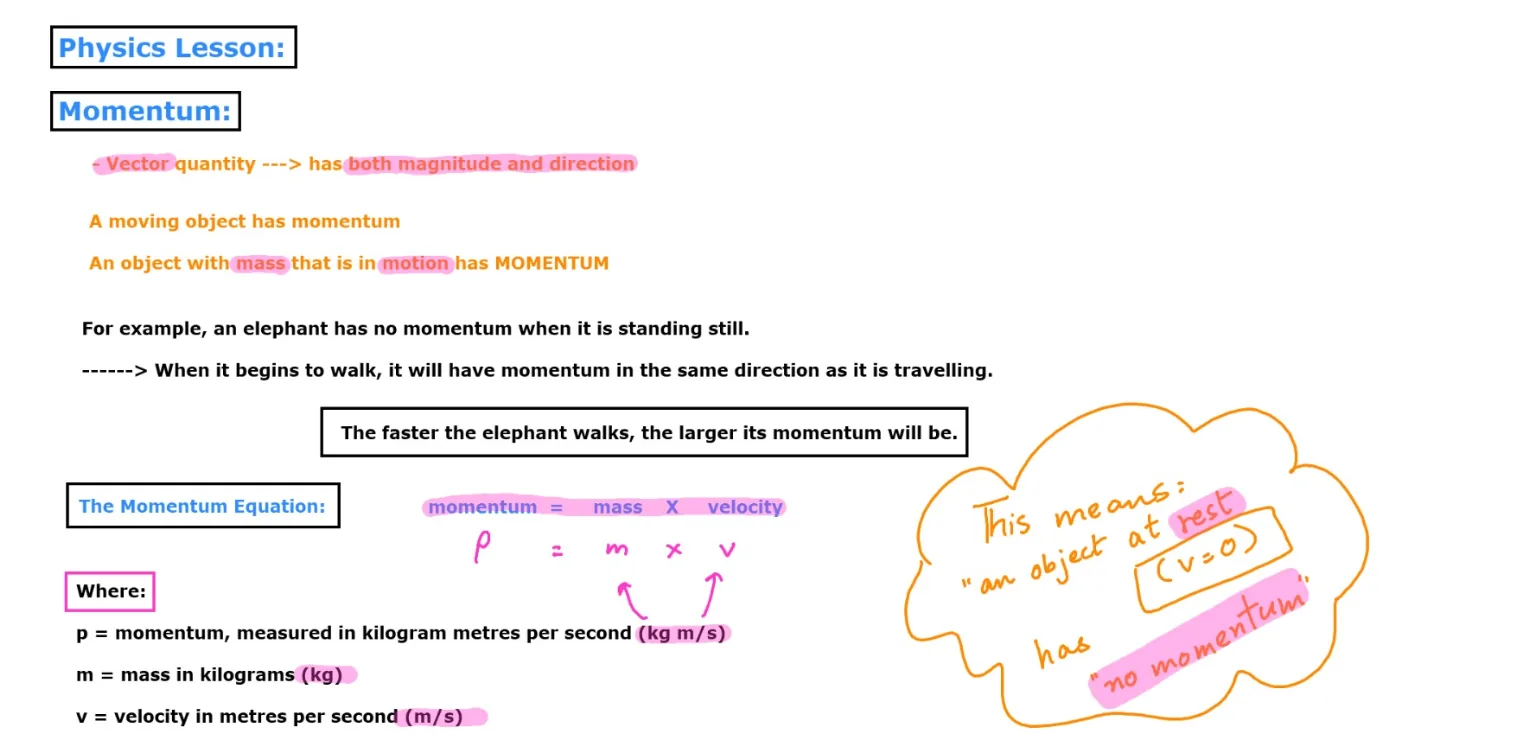
- An object with mass that is in motion has momentum.
- Momentum is a vector quantity: it has both magnitude (size) and direction.
- An object at rest (v = 0) has no momentum. An elephant standing still has no momentum; when it starts to walk, it has momentum in the direction it is travelling.
- The faster it moves, or the heavier it is, the larger its momentum.
How do you calculate momentum? (p = mv)
momentum = mass × velocity p = m × v
| Symbol | Quantity | Unit |
|---|---|---|
| p | momentum | kilogram metres per second (kg m/s) |
| m | mass | kilograms (kg) |
| v | velocity | metres per second (m/s) |
Worked example 1: the lorry
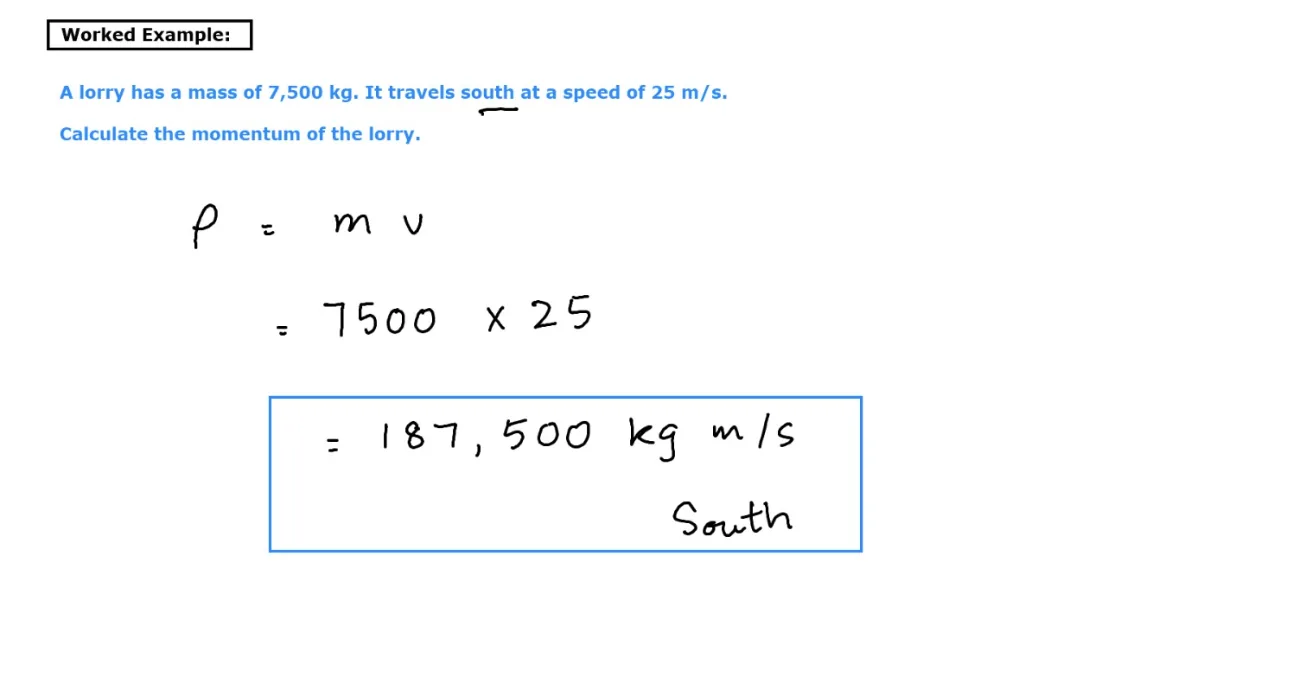
A lorry has a mass of 7500 kg. It travels south at 25 m/s. Calculate its momentum.
- p = mv = 7500 × 25
- = 187 500 kg m/s south – always give the direction, because momentum is a vector.
Why can momentum be negative?
- Velocity is a vector, so momentum depends on the direction of travel.
- Choose one direction as positive (usually right or up). Anything moving the opposite way has a negative velocity and negative momentum.
Worked example 2: the tennis ball
A 60 g tennis ball hits a wall at 2.0 m/s and bounces back at 2.0 m/s. Find its momentum before and after.
- Convert the mass: 60 g = 0.060 kg (= 6.0 × 10⁻² kg).
- Before: p = 0.060 × 2.0 = +0.12 kg m/s
- After (opposite direction, so v = −2.0 m/s): p = 0.060 × (−2.0) = −0.12 kg m/s
- Change in momentum = −0.12 − 0.12 = −0.24 kg m/s
What is conservation of momentum?
- In a closed system – one that is not affected by external forces – total momentum before an event = total momentum after the event.
- The “event” can be a collision (objects hit and bounce or stick together) or an explosion (objects push apart).
- In an explosion from rest, the total momentum before is zero, so afterwards the parts have equal and opposite momenta (this is why a gun recoils).
Worked example 3: two cars stick together
Car A (1200 kg) at 15 m/s hits car B (800 kg) at rest. They stick together. Find their velocity.
- Momentum before = 1200 × 15 + 800 × 0 = 18 000 kg m/s
- Momentum after = momentum before = 18 000 kg m/s; total mass = 2000 kg
- v = 18 000 ÷ 2000 = 9.0 m/s in the original direction
Worked example 4: recoil of a rifle
A 4.0 kg rifle fires a 0.010 kg bullet at 400 m/s. Find the recoil velocity.
- Total momentum before = 0
- Bullet: 0.010 × 400 = 4.0 kg m/s, so the rifle needs −4.0 kg m/s
- v = −4.0 ÷ 4.0 = −1.0 m/s (1.0 m/s backwards)
How are force and momentum linked?
- A resultant force changes an object’s momentum. Force = change in momentum ÷ time taken: F = Δp ÷ Δt (or F = mΔv ÷ Δt).
- For the same change in momentum, a longer time means a smaller force; a short, sharp impact means a large force.
Worked example 5: kicking a football
A 0.45 kg ball is kicked from rest to 20 m/s. The foot touches it for 0.050 s. Find the average force.
- Δp = 0.45 × 20 = 9.0 kg m/s
- F = 9.0 ÷ 0.050 = 180 N
What is impulse? IGCSE Extended
- Impulse = force × time for which the force acts = FΔt.
- Impulse = change in momentum: FΔt = Δ(mv).
- Unit: N s, which is the same as kg m/s.
- Example: a 30 N force acts for 10 s → impulse = 300 N s, so the momentum increases by 300 kg m/s.
How do safety features use momentum? GCSE Physics
- Air bags, seat belts, crumple zones, cycle helmets and cushioned playground or gym surfaces all work in the same way.
- They increase the time taken for the momentum to change (for the person to stop).
- The change in momentum is the same, so the rate of change of momentum is smaller – this means a smaller force and less injury.
The air bag increases the time taken for the driver to stop. The change in momentum is the same, so the rate of change of momentum is smaller. This means the force on the driver is smaller.
Momentum calculator
1. Momentum of one object (p = mv)
Use a negative velocity for the opposite direction.
2. Collision: two objects stick together
Uses conservation of momentum. Use negative velocities for objects moving the other way.
Common mistakes
- Forgetting to convert grams to kilograms. 60 g = 0.060 kg (6.0 × 10⁻² kg), not 6.0 × 10⁻³ kg.
- Leaving out the direction or the minus sign. Momentum is a vector.
- Saying a stationary object has some momentum. v = 0, so p = 0.
- Adding masses before a collision when the objects do not stick together. Work out each momentum separately.
- Saying an air bag “reduces the change in momentum”. The change is the same; it is the time that increases and the force that decreases.
Practice questions
Try each question first, then open it to check your answer.
Q1. A 0.50 kg ball moves at 8.0 m/s. Calculate its momentum.
p = mv = 0.50 × 8.0 = 4.0 kg m/s
Q2. A car has a momentum of 24 000 kg m/s and a mass of 1500 kg. Calculate its velocity.
v = p ÷ m = 24 000 ÷ 1500 = 16 m/s
Q3. Why does a stationary object have no momentum?
Its velocity is zero, so p = m × 0 = 0.
Q4. A 3.0 kg trolley at 4.0 m/s hits a 1.0 kg trolley at rest. They stick together. Find their velocity.
Before: 3.0 × 4.0 = 12 kg m/s. After: 12 ÷ 4.0 = 3.0 m/s in the same direction.
Q5. A 50 kg skater at rest throws a 2.0 kg ball forwards at 10 m/s. Find the skater’s velocity.
Total momentum before = 0. Ball: 2.0 × 10 = 20 kg m/s, so skater: 20 ÷ 50 = 0.40 m/s backwards.
Q6. A force acts on a 0.16 kg cricket ball for 0.020 s and changes its velocity from 0 to 30 m/s. Calculate the force.
Δp = 0.16 × 30 = 4.8 kg m/s. F = Δp ÷ t = 4.8 ÷ 0.020 = 240 N
Q7. Explain how a crumple zone protects passengers.
It increases the time taken for the car to stop. The change in momentum is the same, so the rate of change of momentum (force) is smaller.
Exam tips
- Write the equation first, then substitute with units: p = mv.
- Draw a quick before and after sketch and mark which direction is positive.
- For conservation questions, start with: “total momentum before = total momentum after”.
- For safety questions, use the chain: longer time → same change in momentum → smaller rate of change → smaller force.
Frequently asked questions
What is momentum in physics?
Momentum is the product of an object’s mass and velocity: p = mv. It is measured in kilogram metres per second (kg m/s). Any object with mass that is moving has momentum.
Is momentum a vector or a scalar?
Momentum is a vector quantity, because velocity is a vector. It has both size and direction, so momentum in the opposite direction is given a negative sign.
Can momentum be negative?
Yes. If one direction is taken as positive, an object moving the opposite way has a negative velocity, so its momentum is negative. For example, a 60 g ball bouncing back at 2 m/s has a momentum of −0.12 kg m/s.
Does an object at rest have momentum?
No. An object at rest has a velocity of zero, so its momentum is zero (p = m × 0 = 0).
What is the law of conservation of momentum?
In a closed system, the total momentum before an event (such as a collision or explosion) is equal to the total momentum after the event. A closed system is one where no external forces act.
What is impulse?
Impulse is force × the time for which the force acts (FΔt). It equals the change in momentum, Δ(mv). Its unit is N s, which is the same as kg m/s. It is in the Extended part of Cambridge IGCSE Physics 0625.
Why do airbags and seat belts reduce injuries?
They increase the time taken for a person to stop in a crash. The change in momentum is the same, so the rate of change of momentum is smaller, which means a smaller force acts on the person.
Is momentum in GCSE Combined Science?
Yes, at Higher tier. AQA Combined Science includes p = mv and conservation of momentum (Higher tier only). Force as the rate of change of momentum and safety features are in AQA GCSE Physics only.
Related notes
- Speed, velocity and acceleration
- Forces and resultant force
- Energy, work and power
- Cambridge IGCSE Physics 0625 past papers
Need help with Physics?
Ms. Asim teaches IGCSE, GCSE and A Level Physics online, 1-to-1, for students in any time zone.
Book a 1-to-1 lesson