
Notes › Chemistry › IGCSE 0620 › Electrolysis
Cambridge IGCSE Chemistry 0620: Electrolysis Notes
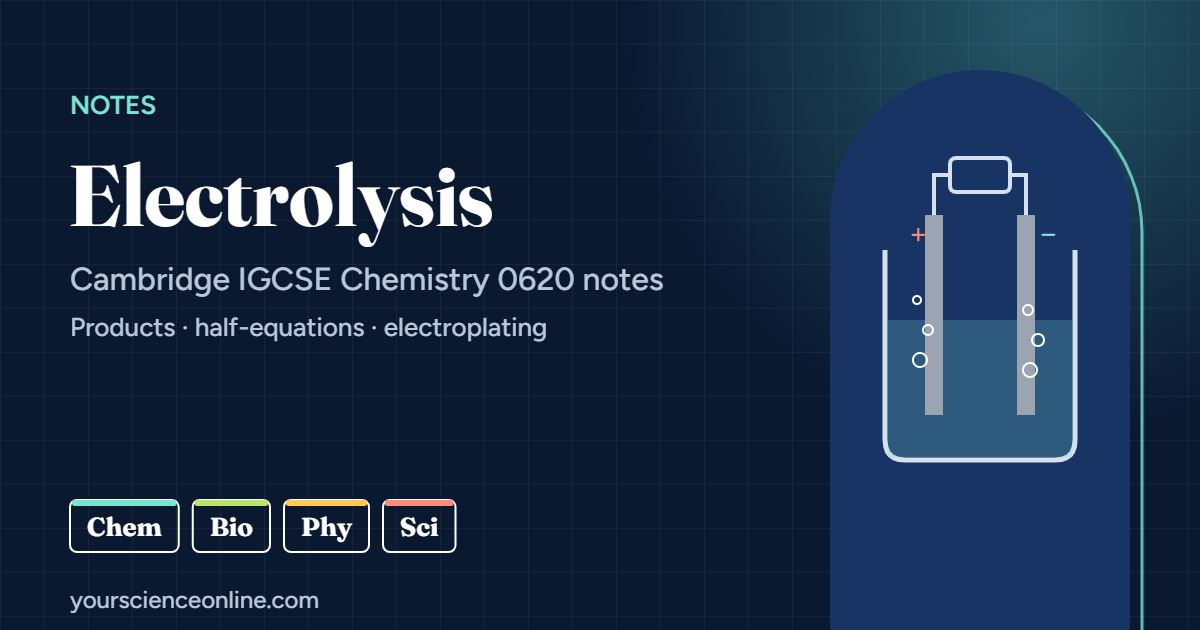
Electrolysis is the breakdown of an ionic compound, when molten or in solution, by an electric current. Positive ions move to the cathode and negative ions move to the anode. These notes explain electrolysis step by step for the Cambridge IGCSE Chemistry (0620) syllabus: how to predict the products, the electrolysis of lead(II) bromide, brine, dilute sulfuric acid and copper(II) sulfate, half-equations, electroplating and fuel cells, with an interactive product predictor, a quiz, worked examples and exam tips.
Try the product predictorBook a 1-to-1 lessonWritten by Ms. Humaira Asim, a science teacher with 15+ years of teaching experience. Written for the Cambridge IGCSE Chemistry 0620 syllabus.
What is electrolysis?
An ionic compound must be molten (melted) or dissolved in water, because only then are its ions free to move. In a solid, the ions are fixed in place, so the compound cannot conduct electricity.
Anode and cathode
| Electrode | Charge | Ions attracted | What happens (Extended) |
|---|---|---|---|
| Anode | Positive (+) | Negative ions (anions), such as Cl⁻, Br⁻, OH⁻ | Ions lose electrons: oxidation |
| Cathode | Negative (−) | Positive ions (cations), such as Pb²⁺, Cu²⁺, H⁺ | Ions gain electrons: reduction |
In the circuit, electrons carry the charge through the wires, and ions carry the charge through the electrolyte. The electrodes are usually inert (unreactive), such as graphite (carbon) or platinum.
Electrolysis of molten compounds
A molten binary compound (made of two elements) contains only two types of ion, so the products are simple: the metal forms at the cathode and the non-metal forms at the anode.
Example: molten lead(II) bromide, PbBr₂
- Cathode: lead forms (silvery liquid metal)
- Anode: bromine forms (red-brown vapour)
This must be done in a fume cupboard, because bromine is toxic.
Electrolysis of aqueous solutions
In a solution, water also provides a small number of H⁺ and OH⁻ ions. So there are two possible ions at each electrode, and only one is discharged. Use these rules:
Predict the products (interactive)
Predict the products
Choose an electrolyte. Try to predict both products first, then press Show the products.
Electrolysis of brine (concentrated sodium chloride solution)
- Cathode: hydrogen gas (sodium is more reactive than hydrogen)
- Anode: chlorine gas (concentrated chloride ions)
- Left in solution: sodium hydroxide
This process is important in industry, because all three products are useful. Test for chlorine: it bleaches damp blue litmus paper. Test for hydrogen: it burns with a squeaky pop.
Electrolysis of dilute sulfuric acid
- Cathode: hydrogen
- Anode: oxygen (sulfate ions are not discharged)
- Twice as much hydrogen as oxygen forms, by volume. Test for oxygen: it relights a glowing splint.
Electrolysis of copper(II) sulfate
| Carbon (graphite) electrodes | Copper electrodes (Extended) | |
|---|---|---|
| Cathode | Copper is deposited | Copper is deposited (cathode gains mass) |
| Anode | Oxygen gas forms | The copper anode dissolves (loses mass) |
| Solution | Blue colour fades; becomes acidic | Blue colour stays the same |
Using copper electrodes is how copper is purified: the impure copper is the anode and pure copper builds up on the cathode.
Half-equations (Extended)
A half-equation shows what happens at one electrode. Electrons (e⁻) are added on the left at the cathode, and appear on the right at the anode. The charges must balance on both sides.
| Electrode | Half-equation |
|---|---|
| Cathode (lead) | Pb²⁺ + 2e⁻ → Pb |
| Cathode (copper) | Cu²⁺ + 2e⁻ → Cu |
| Cathode (hydrogen) | 2H⁺ + 2e⁻ → H₂ |
| Anode (chlorine) | 2Cl⁻ → Cl₂ + 2e⁻ |
| Anode (bromine) | 2Br⁻ → Br₂ + 2e⁻ |
| Anode (oxygen) | 4OH⁻ → O₂ + 2H₂O + 4e⁻ |
Electroplating
Electroplating uses electrolysis to coat an object with a thin layer of metal. It is used to make objects look better (for example silver-plated cutlery) and to stop them corroding (for example chromium-plated taps).
- The object to be plated is the cathode.
- The anode is made of the plating metal.
- The electrolyte contains ions of the plating metal.
Hydrogen–oxygen fuel cells
A fuel cell uses the reaction between hydrogen and oxygen to produce electricity. The only product is water. Advantages: no carbon dioxide is released, and it is more efficient than burning fuel. Disadvantages: hydrogen is difficult to store, and it is often made using fossil fuels. Check whether fuel cells are on your syllabus.
Worked examples
Example 1: molten zinc chloride
Predict the products at each electrode when molten zinc chloride, ZnCl₂, is electrolysed.
- It is molten, so there are only two ions: Zn²⁺ and Cl⁻
- Cathode: zinc (Zn²⁺ + 2e⁻ → Zn)
- Anode: chlorine (2Cl⁻ → Cl₂ + 2e⁻)
Example 2: concentrated copper(II) chloride solution
Predict the products when concentrated copper(II) chloride solution is electrolysed with carbon electrodes.
- Cathode: copper is less reactive than hydrogen, so copper is deposited
- Anode: it is a concentrated chloride, so chlorine forms
Example 3: potassium iodide solution
Predict the products when concentrated potassium iodide solution is electrolysed.
- Cathode: potassium is more reactive than hydrogen, so hydrogen forms
- Anode: concentrated iodide, so iodine forms (the solution turns brown)
Example 4: electroplating
Describe how to electroplate an iron key with nickel.
- Make the key the cathode
- Make a bar of nickel the anode
- Use an electrolyte containing nickel ions, such as nickel sulfate solution, and pass a current
Example 5: writing a half-equation
Write the half-equation for the formation of oxygen at the anode.
- Hydroxide ions lose electrons
- 4OH⁻ → O₂ + 2H₂O + 4e⁻
- Check: charge on the left is 4−; on the right, 4e⁻ gives 4−. Balanced.
Quick quiz
Quick quiz: electrolysis
Choose an answer for each question. You get feedback straight away.
1. Which electrode do positive ions move to?
2. What forms at the anode when concentrated sodium chloride solution is electrolysed?
3. What forms at the cathode when concentrated sodium chloride solution is electrolysed?
4. Why must an ionic compound be molten or dissolved before electrolysis?
5. In electroplating, the object being plated is the…
6. What forms at the cathode when copper(II) sulfate solution is electrolysed?
7. Which half-equation shows what happens at the anode with molten lead(II) bromide?
8. What happens to the blue colour of copper(II) sulfate solution with carbon electrodes?
Common mistakes
- Mixing up anode and cathode. Remember PANIC: Positive Anode, Negative Is Cathode.
- Saying “sodium forms” from brine. In solution, hydrogen forms at the cathode, because sodium is more reactive than hydrogen.
- Saying electrons move through the electrolyte. Ions move through the electrolyte; electrons move through the wires.
- Writing “chlorine ions”. The ions are chloride ions (Cl⁻); chlorine is the gas (Cl₂).
- Unbalanced half-equations. Check that the atoms and the charges balance.
Practice questions
Try each question first, then open it to check your answer.
Q1. Define electrolysis.
Electrolysis is the decomposition of an ionic compound, when molten or in aqueous solution, by the passage of an electric current.
Q2. Why does solid sodium chloride not conduct electricity?
In a solid, the ions are held in fixed positions and cannot move.
Q3. Name the products when molten potassium bromide is electrolysed.
Potassium at the cathode, bromine at the anode.
Q4. Name the three products of the electrolysis of brine.
Hydrogen, chlorine and sodium hydroxide.
Q5. Describe a test for the gas made at the cathode when dilute sulfuric acid is electrolysed.
The gas is hydrogen. Hold a lit splint near it: it burns with a squeaky pop.
Q6. Copper(II) sulfate solution is electrolysed with carbon electrodes. Explain why the blue colour fades.
Cu²⁺ ions, which make the solution blue, are removed as copper is deposited on the cathode.
Q7. Write the half-equation for the reaction at the cathode when molten aluminium oxide is electrolysed.
Al³⁺ + 3e⁻ → Al
Q8. Give two reasons for electroplating objects.
To improve their appearance and to prevent corrosion (rusting).
Exam tips
- First decide: is it molten or aqueous? Then use the right rules.
- For aqueous solutions, use the reactivity series at the cathode and “concentrated halide?” at the anode.
- Give observations as well as names: “bubbles of gas”, “pink-brown solid”, “blue colour fades”.
- Learn the three gas tests: hydrogen (squeaky pop), oxygen (relights a glowing splint), chlorine (bleaches damp litmus paper).
Frequently asked questions
Is the anode positive or negative in electrolysis?
In electrolysis, the anode is the positive electrode and the cathode is the negative electrode.
Why is hydrogen produced instead of sodium when brine is electrolysed?
Sodium is more reactive than hydrogen. In a solution, the less reactive of the two possible products is discharged at the cathode, so hydrogen forms.
Why are graphite electrodes used?
Graphite is inert (unreactive), conducts electricity and has a very high melting point, so it does not react with the products.
What is the difference between electrolysis of a molten compound and a solution?
A molten compound contains only its own two ions. A solution also contains H⁺ and OH⁻ ions from water, so hydrogen or oxygen may be produced instead.
Need help with Chemistry?
Ms. Asim teaches IGCSE, GCSE and A Level Chemistry online, 1-to-1, for students in any time zone.
Book a 1-to-1 lessonOpen the periodic tableRelated notes: Atomic structure · The mole and stoichiometry. This topic is also part of GCSE and IGCSE Combined Science: see all Combined Science notes. These notes follow the Cambridge IGCSE Chemistry 0620 syllabus. Always check the current syllabus on the Cambridge International website.