
Home › Teacher Resources › Lower Secondary › Year 7 › Forces and Motion
Year 7 Forces Worksheets: Part 1 and Part 2 (with Mark Schemes)
Quick answer: two free, printable Year 7 forces worksheets, each with its own mark scheme. Part 1 covers forces and motion (speed and distance-time graphs); Part 2 covers pushes and pulls, contact and non-contact forces, and balanced forces.
A printable Year 7 physics worksheet on forces and motion. Students name forces, compare balanced and unbalanced forces, calculate speed and read distance-time graphs. A full mark scheme is included.
- Year 7
- KS3 Physics
- GCSE foundations
- Part 1: 39 marks
- Part 2: 35 marks
- Free PDF
Part 1: Forces and Motion (39 marks)
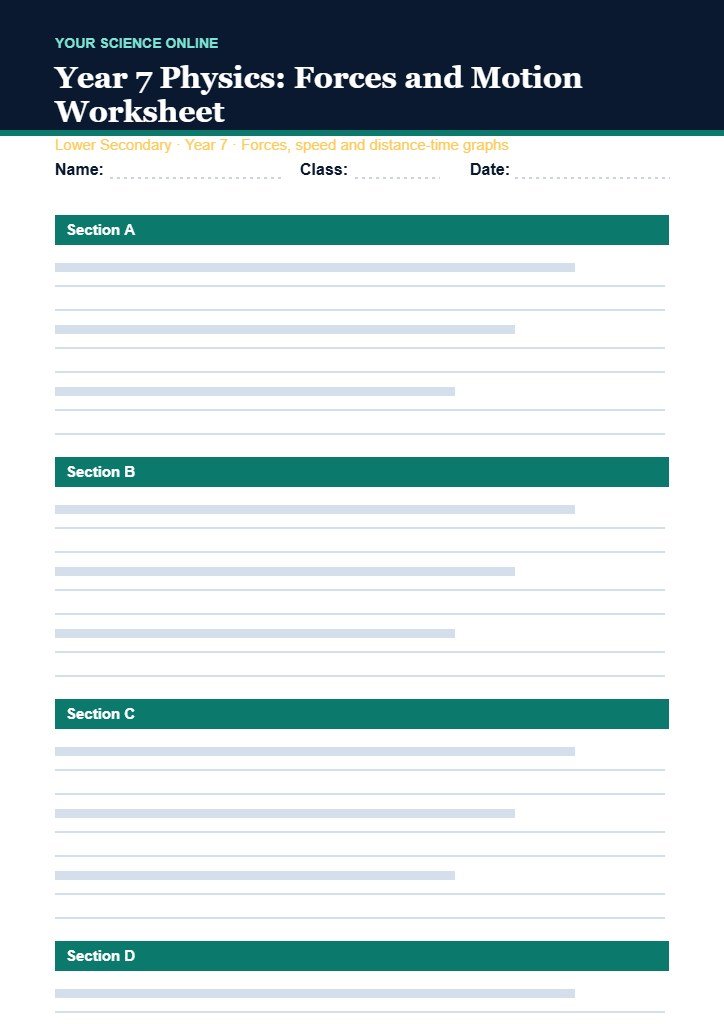
What Part 1 covers
| Section | Topic | What students do | Marks |
|---|---|---|---|
| A | Forces | Types of force and their units | 12 |
| B | Balanced and unbalanced forces | Balanced and unbalanced forces | 9 |
| C | Speed | Calculating speed | 9 |
| D | Distance-time graphs | Distance-time graphs | 9 |
| Total | 39 | ||
Part 2: Pushes, Pulls, Contact and Non-Contact Forces (35 marks)
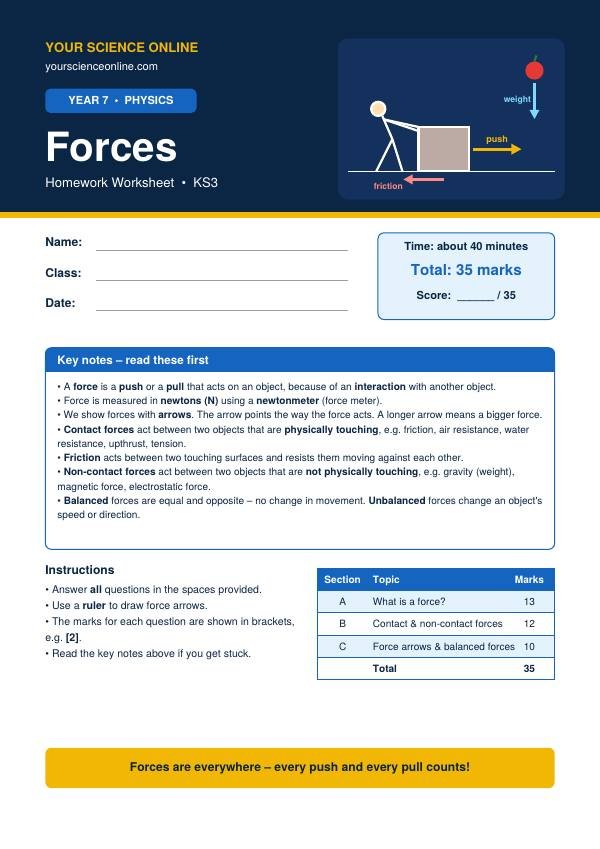
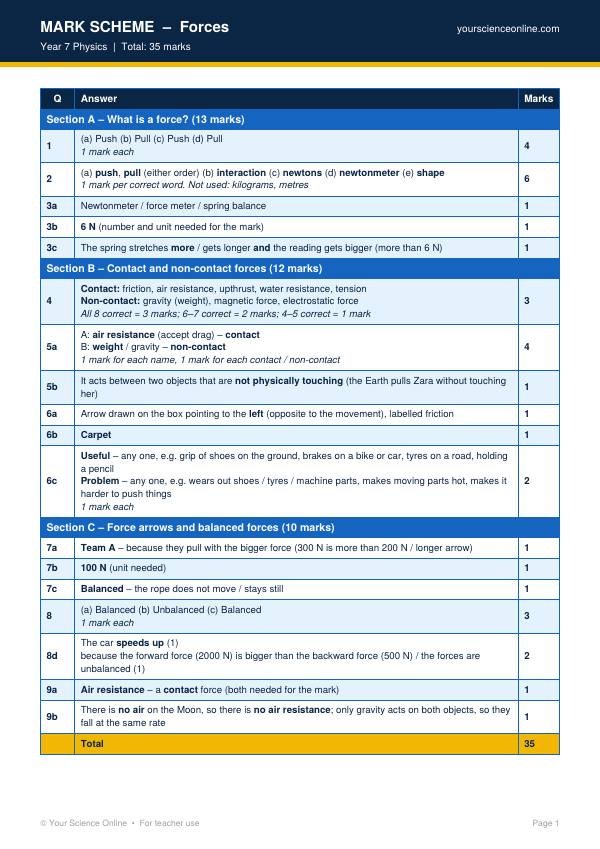
Part 2 is a 40-minute homework worksheet with key notes at the top. Students decide whether forces are pushes or pulls, read a newtonmeter, sort contact and non-contact forces, draw force arrows and decide whether forces are balanced. It ends with a challenge question on the hammer and feather on Earth and on the Moon.
What Part 2 covers
| Section | Topic | Marks |
|---|---|---|
| A | What is a force? Pushes, pulls, newtons and newtonmeters | 13 |
| B | Contact and non-contact forces, friction and gravity | 12 |
| C | Force arrows and balanced forces, plus a challenge question | 10 |
| Total | 35 | |
Skills students practise
- Naming forces
- Describing balanced and unbalanced forces
- Calculating speed
- Reading distance-time graphs
- Planning a speed measurement
How to use it
- Download and print the worksheet, single- or double-sided.
- Set it as classwork, homework or a revision task.
- Use the mark scheme to mark it yourself, or let students self-assess or peer-assess.
Frequently asked questions
Does this worksheet come with answers?
Yes. A separate mark scheme (1 pages, A4) gives the answers and marking guidance for all 39 marks.
Is the worksheet free?
Yes. Both PDFs are free to download, print and use with your own students.
Which level is it for?
It is written for Year 7, KS3. Always check it against your own scheme of work or exam specification.
Which year group is this worksheet for?
It is written for Year 7 (ages 11 to 12) and matches the KS3 forces and motion topic.
What is the difference between Part 1 and Part 2?
Part 1 (39 marks) covers forces and motion, including speed calculations and distance-time graphs. Part 2 (35 marks) focuses on pushes and pulls, contact and non-contact forces, force arrows and balanced forces. Each part has its own mark scheme, so you can set them separately.
More resources: Physics calculators · More Year 7 worksheets
Need help teaching this topic?
Ms. Humaira Asim, a science teacher with 15+ years of experience, offers 1-to-1 online science lessons for students in any time zone.
Book a 1-to-1 lesson