
Home › Teacher Resources › Upper Secondary › Year 10/11 › Chemistry › Rates of Reaction
GCSE and IGCSE Rates of Reaction Worksheet (with Mark Scheme)
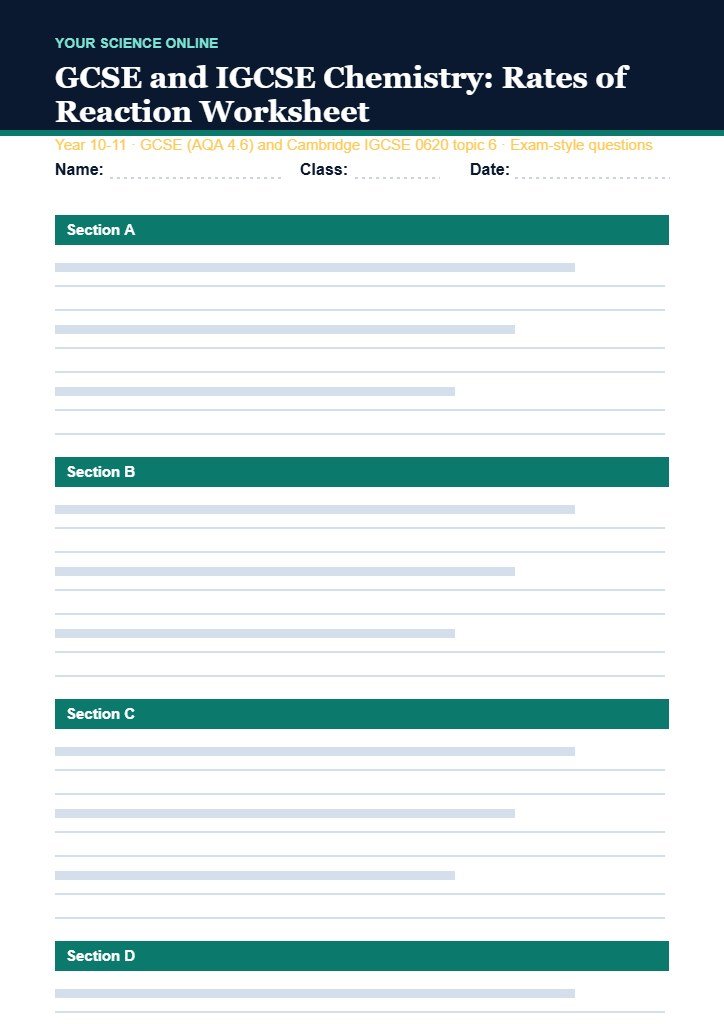
A printable GCSE and IGCSE chemistry worksheet on rates of reaction with exam-style questions. Students use collision theory, explain the effect of concentration, surface area, temperature and catalysts, analyse rate graphs, calculate mean rate and apply equilibrium ideas to the Haber process. A full mark scheme with marking guidance is included.
- Year 10-11
- GCSE and IGCSE Chemistry
- Exam-style questions
- 39 marks
- Free PDF
What the worksheet covers
| Section | Topic | What students do | Marks |
|---|---|---|---|
| A | Collision theory | Collision theory and factors affecting rate | 14 |
| B | Measuring rate | Measuring rate and interpreting graphs | 12 |
| C | Catalysts, energy and reversible reactions | Catalysts and reaction profiles | 13 |
| Total | 39 | ||
Skills students practise
- Explaining rate using collision theory
- Interpreting rate graphs
- Calculating mean rate
- Explaining how catalysts work
- Applying equilibrium ideas
How to use it
- Download and print the worksheet, single- or double-sided.
- Set it as classwork, homework or a revision task.
- Use the mark scheme to mark it yourself, or let students self-assess or peer-assess.
Frequently asked questions
Does this worksheet come with answers?
Yes. A separate mark scheme (1 pages, A4) gives the answers and marking guidance for all 39 marks.
Is the worksheet free?
Yes. Both PDFs are free to download, print and use with your own students.
Which level is it for?
It is written for Year 10-11, GCSE and IGCSE. Always check it against your own scheme of work or exam specification.
Is this worksheet suitable for AQA GCSE and Cambridge IGCSE?
Yes. It covers AQA GCSE Chemistry 4.6 and Cambridge IGCSE Chemistry 0620 topic 6. Higher tier and Extended questions are labelled.
More resources: Electrolysis worksheet · More Chemistry worksheets
Need help teaching this topic?
Ms. Humaira Asim, a science teacher with 15+ years of experience, offers 1-to-1 online science lessons for students in any time zone.
Book a 1-to-1 lesson