
Notes › GCSE › Biology › Transport in cells
GCSE Biology Transport in Cells Notes: Diffusion, Osmosis and Active Transport (AQA 8461)
Diffusion, osmosis and active transport, surface area to volume ratio, exchange surfaces and required practical 3, in quick bullet points. Follows AQA GCSE Biology 4.1.3.
Watch the diffusion simulationBook a 1-to-1 lessonWritten by Ms. Humaira Asim, a science teacher with 15+ years of teaching experience. Checked against the AQA GCSE Biology (8461) specification, section 4.1.3.
Diffusion = particles spread from high to low concentration (no energy). Osmosis = diffusion of water across a partially permeable membrane, dilute → concentrated. Active transport = dilute → concentrated, against the gradient, using energy from respiration. Big organisms need exchange surfaces because their surface area to volume ratio is small.
- Only in AQA: surface area to volume ratio calculations, exchange surfaces (lungs, small intestine, gills, roots, leaves), required practical 3 with percentage change in mass, isotonic drinks.
- Only in IGCSE: water potential, the words turgid / flaccid / plasmolysed, and protein carriers (Extended). AQA just says “against the concentration gradient”.
- Same in both: the three definitions, and the factors affecting diffusion.
- Studying Cambridge IGCSE instead? See the IGCSE Diffusion, osmosis and active transport notes.
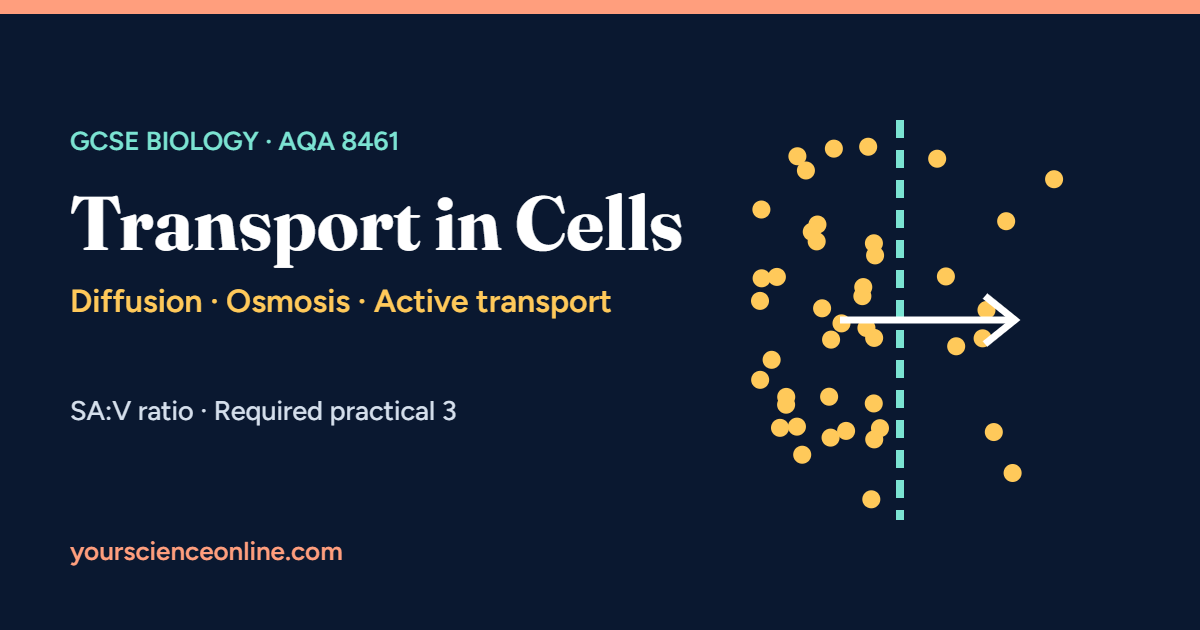
What is diffusion?
- Definition: the spreading out of particles of a gas, or a substance in solution, from an area of higher concentration to an area of lower concentration.
- No energy needed – particles move randomly.
- Examples: oxygen and carbon dioxide in gas exchange; urea from cells into blood plasma for excretion by the kidneys.
What affects the rate of diffusion?
Concentration gradient · Temperature · Surface area of the membrane
| Factor | Faster when | Why |
|---|---|---|
| Concentration gradient | Steeper | Bigger difference = bigger net movement |
| Temperature | Higher | Particles have more kinetic energy |
| Surface area | Larger | More particles cross at once |
Diffusion simulation
Watch diffusion happen
Press Remove the barrier and watch the particles spread out. Then try a higher temperature: the particles move faster, so diffusion happens faster.
Particles on the right: 0%
What is surface area to volume ratio?
A single-celled organism (big SA:V) can rely on diffusion. A multicellular organism (small SA:V) needs exchange surfaces and a transport system.
- For a cube: SA = 6 × side², V = side³, then write SA : V as a ratio to 1.
- As size goes up, SA:V goes down.
How are exchange surfaces adapted?
| Adaptation | Why it helps | Example |
|---|---|---|
| Large surface area | More room for diffusion | Villi in the small intestine; alveoli |
| Thin membrane | Short diffusion path | Alveoli walls one cell thick |
| Good blood supply (animals) | Keeps the gradient steep | Capillaries around alveoli and villi |
| Ventilation (animals, gases) | Refreshes the air, keeps the gradient steep | Breathing; water over gills |
- Plants: root hairs (large surface area for water and ions) and leaves (thin, with air spaces and stomata).
What is osmosis?
- Definition: the diffusion of water from a dilute solution to a more concentrated solution through a partially permeable membrane.
- Plant cells in water become firm; in a concentrated solution they lose water and go soft.
- Animal cells have no cell wall: they can burst in pure water or shrink in a concentrated solution.
- Isotonic drinks match body fluid concentration so they are absorbed without disturbing cells.
Required practical 3: osmosis in potato
- Cut equal-sized potato cylinders; blot dry and weigh each one.
- Put each in a different sugar (or salt) solution concentration for the same time at the same temperature.
- Remove, blot dry, weigh again.
- Calculate percentage change in mass = (final − start) ÷ start × 100.
- Plot % change against concentration. Where the line crosses 0%, the solution has the same concentration as the potato cells.
- Why blot dry? So surface water isn’t weighed.
- Why percentage change? So pieces with different starting masses can be compared fairly.
- Control variables: time, temperature, potato type, size of pieces.
What is active transport?
- Definition: moves substances from a more dilute solution to a more concentrated solution (against the concentration gradient). It requires energy from respiration.
- Plants: root hair cells absorb mineral ions from very dilute soil solutions.
- Animals: sugar absorbed from the gut into the blood when the blood already has more sugar.
Diffusion vs osmosis vs active transport
| Diffusion | Osmosis | Active transport | |
|---|---|---|---|
| What moves | Gas or solute particles | Water | Ions, sugars… |
| Direction | High → low | Dilute → concentrated | Dilute → concentrated |
| Membrane needed? | No | Partially permeable | Yes |
| Energy from respiration? | No | No | Yes |
Worked examples
Example 1: surface area to volume ratio
Calculate the SA:V ratio of a 2 cm cube.
- SA = 6 × 2² = 24 cm²
- V = 2³ = 8 cm³
- SA:V = 24 : 8 = 3 : 1
Example 2: percentage change in mass
A potato cylinder goes from 2.50 g to 2.80 g in pure water. Calculate the percentage change.
- Change = 2.80 − 2.50 = +0.30 g
- % change = 0.30 ÷ 2.50 × 100 = +12%
- Water entered the cells by osmosis
Example 3: reading the graph
On the graph, % change is 0 at 0.3 mol/dm³. What does this tell you?
- No net water movement at that concentration
- The potato cells have the same concentration as a 0.3 mol/dm³ solution
Calculators
Surface area : volume (cube)
SA = 6 × side² · V = side³
Percentage change in mass
(final − start) ÷ start × 100
Quick quiz
Quick quiz: transport in cells (AQA)
Instant feedback on every answer.
1. Oxygen moves from the alveoli into the blood. Which process?
2. Sugar is absorbed from the gut into blood that already has a higher sugar concentration. Which process?
3. A 1 cm cube has a surface area to volume ratio of…
4. Which does NOT make an exchange surface more effective?
5. In required practical 3, why do you calculate percentage change in mass?
6. A potato chip in a very concentrated sugar solution will…
Common mistakes
- “Water moves to where there is more water.” Say dilute → concentrated solution.
- Forgetting the membrane in the osmosis definition.
- Saying active transport is just “fast diffusion”. It goes against the gradient and needs energy.
- Not converting to percentage change in required practical 3.
- Mixing up SA:V direction: bigger organism = smaller ratio.
Frequently asked questions
What is the difference between diffusion, osmosis and active transport?
Diffusion: particles move from high to low concentration, no energy needed. Osmosis: water moves through a partially permeable membrane from a dilute to a concentrated solution. Active transport: particles move from low to high concentration using energy from respiration.
Why do multicellular organisms need exchange surfaces?
Large organisms have a small surface area to volume ratio, so diffusion through the outer surface is too slow. Specialised exchange surfaces (lungs, small intestine, gills, roots, leaves) and transport systems move enough substances in and out.
What is required practical 3 in AQA GCSE Biology?
Investigating the effect of a range of sugar or salt solution concentrations on the mass of plant tissue, usually potato, and calculating the percentage change in mass.
Why are isotonic drinks used in sport?
An isotonic drink has the same concentration as body fluids, so water and ions are absorbed without upsetting osmosis in cells.
Need help with GCSE Biology?
Ms. Asim teaches AQA GCSE and IGCSE Biology online, 1-to-1, for students in any time zone.
Book a 1-to-1 lessonPrevious topic: cell structureThese notes follow the AQA GCSE Biology (8461) specification, section 4.1.3. Always check the current specification on the AQA website. Also see: IGCSE version · Combined Science notes.