
Home › Teacher Resources › Lower Secondary › Year 9 › Breathing and Gas Exchange
Year 9 Breathing and Gas Exchange Worksheet (with Mark Scheme)
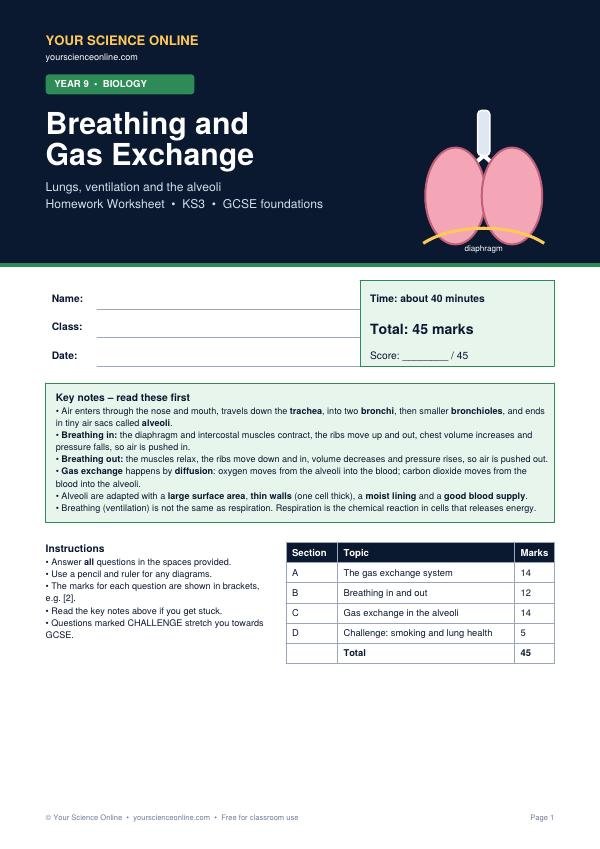
Quick answer: This free Year 9 (KS3) biology worksheet tests the gas exchange system, how breathing in and out works, and how gases diffuse in the alveoli. It has 45 marks, takes about 40 minutes, and comes with a separate mark scheme.
Students label the lungs, explain breathing with the bell jar model, compare inhaled and exhaled air, describe how alveoli are adapted for diffusion, and finish with a challenge on smoking and lung health.
- Year 9
- KS3 Biology
- GCSE foundations
- 45 marks
- Free PDF
What does the worksheet cover?
| Section | Topic | What students do | Marks |
|---|---|---|---|
| A | The gas exchange system | Labelling the lungs, airways, mucus and cilia | 14 |
| B | Breathing in and out | Muscles, ribs, volume and pressure; the bell jar model; breathing rate | 12 |
| C | Gas exchange in the alveoli | Diffusion of oxygen and carbon dioxide, alveoli adaptations, inhaled vs exhaled air | 14 |
| D | Challenge | Smoking, cilia, carbon monoxide and emphysema | 5 |
| Total | 45 | ||
Which skills do students practise?
- Labelling the human gas exchange system
- Explaining inhaling and exhaling using volume and pressure
- Evaluating the bell jar model
- Explaining how alveoli are adapted for diffusion
- Interpreting data on inhaled and exhaled air
How should you use it?
- Download and print the worksheet, single- or double-sided.
- Set it as classwork, homework or a revision task (about 40 minutes).
- Use the mark scheme to mark it yourself, or let students self-assess or peer-assess.
Frequently asked questions
Does this worksheet come with answers?
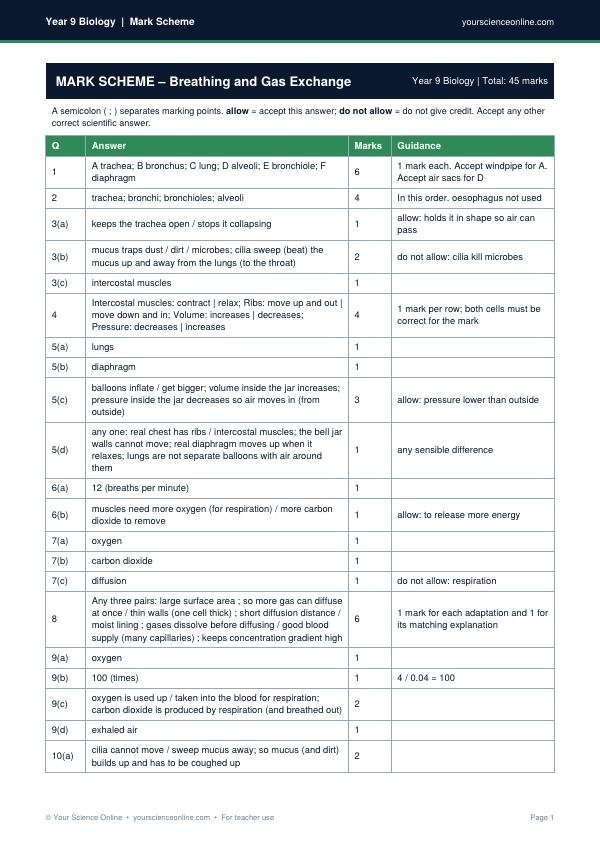
Yes. A separate mark scheme (2 pages, A4) gives the answers and marking guidance for all 45 marks.
Is the worksheet free?
Yes. Both PDFs are free to download, print and use with your own students.
What is gas exchange in Year 9 science?
Gas exchange is the movement of oxygen from the alveoli into the blood and of carbon dioxide from the blood into the alveoli, by diffusion.
How are the alveoli adapted for gas exchange?
They have a large surface area, thin walls only one cell thick, a moist lining and a good blood supply, which all make diffusion fast.
Which level is it for?
It is written for Year 9, KS3, and builds foundations for GCSE and IGCSE. Always check it against your own scheme of work.
More resources: IGCSE Biology notes topic list · Respiration notes · GCSE respiration worksheet · More Year 9 worksheets
Need help teaching this topic?
Ms. Humaira Asim, a science teacher with 15+ years of experience, offers 1-to-1 online science lessons for students in any time zone.
Book a 1-to-1 lesson