
Home › Teacher Resources › Lower Secondary › Year 9 › The Periodic Table
Year 9 Periodic Table Worksheet (with Mark Scheme)
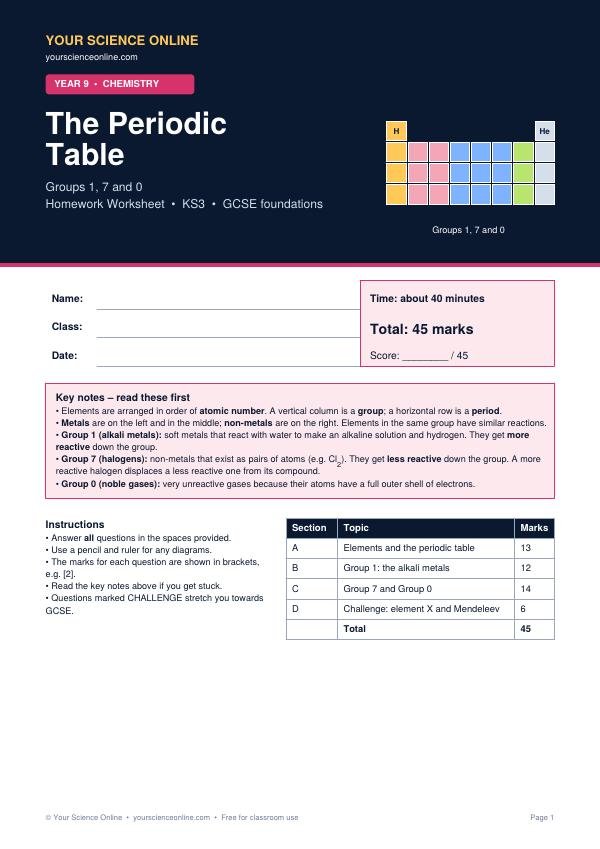
Quick answer: This free Year 9 (KS3) chemistry worksheet covers groups and periods, metals and non-metals, and the trends in Group 1, Group 7 and Group 0. It has 45 marks, takes about 40 minutes, and comes with a separate mark scheme.
Students read an outline periodic table, use reactivity and melting point data for the alkali metals, write word equations, explain halogen displacement and noble gas uses, and finish with a challenge on Mendeleev.
- Year 9
- KS3 Chemistry
- GCSE foundations
- 45 marks
- Free PDF
What does the worksheet cover?
| Section | Topic | What students do | Marks |
|---|---|---|---|
| A | Elements and the periodic table | Groups, periods, metals and non-metals | 13 |
| B | Group 1: the alkali metals | Reactions with water, trends, word equations, safety | 12 |
| C | Group 7 and Group 0 | Halogen trends, displacement reactions, noble gas uses | 14 |
| D | Challenge | Identifying element X; Mendeleev and the gaps | 6 |
| Total | 45 | ||
Which skills do students practise?
- Using groups and periods to locate elements
- Describing trends in reactivity down Group 1 and Group 7
- Writing word equations
- Explaining displacement reactions of halogens
- Linking properties of noble gases to their uses
How should you use it?
- Download and print the worksheet, single- or double-sided.
- Set it as classwork, homework or a revision task (about 40 minutes).
- Use the mark scheme to mark it yourself, or let students self-assess or peer-assess.
Frequently asked questions
Does this worksheet come with answers?
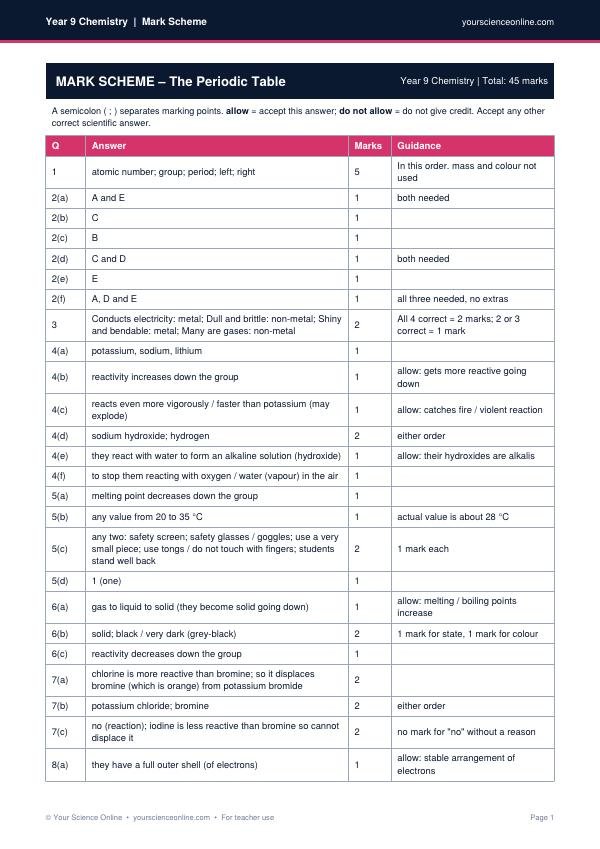
Yes. A separate mark scheme (2 pages, A4) gives the answers and marking guidance for all 45 marks.
Is the worksheet free?
Yes. Both PDFs are free to download, print and use with your own students.
Why do Group 1 metals get more reactive down the group?
The outer electron is further from the nucleus, so it is lost more easily. At KS3, students just need to describe the trend: reactivity increases down Group 1.
Why are noble gases unreactive?
Their atoms have a full outer shell of electrons, so they do not need to gain, lose or share electrons.
Which level is it for?
It is written for Year 9, KS3, and builds foundations for GCSE and IGCSE. Always check it against your own scheme of work.
More resources: Interactive periodic table · Chemistry notes topic list · Atomic structure notes · More Year 9 worksheets
Need help teaching this topic?
Ms. Humaira Asim, a science teacher with 15+ years of experience, offers 1-to-1 online science lessons for students in any time zone.
Book a 1-to-1 lesson